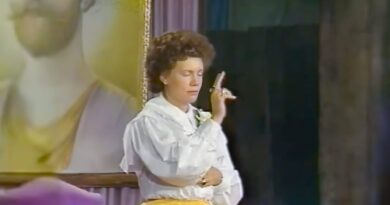
Lecture on Francis Bacon (Saint Germain), The Golden Age Prince – October 10, 1983
Lecture on Francis Bacon (Saint Germain)
The Golden Age Prince – October 10, 1983
LECTURE TRANSCRIPT
Discover the New Age with Saint Germain
Bold = Lecture notes
I’d like to tell you a story about the golden age prince.
The Golden Age Prince
In November of 1572 a star flashed out of the constellation Cassiopeia, startling the world.Brighter than Venus, it was clearly visible even in the light of day.
Many who saw it reported that this “guest star,” as the comet was called, had a remarkable similarity to the luminous star that guided the magi‑-the Bethlehem star.
Its coming amazed the world.
But while astronomers were baffled by its appearance, the great Swiss mystic‑physician Paracelsus had prophesied the coming of the special star more than a century earlier, calling it a “harbinger of a great renovation of society.”
“There is nothing concealed that will not be revealed,” he said.”The comet will announce the presence of a marvelous being who as yet lives not but who will reveal many things.”This “marvelous being” would be a master of all arts, and would come bringing three treasures for mankind, gifts that would change the face of the world.
This prophecy by Paracelsus, delivered in the fifteenth century, foretelling a “renovation of society,” came at an unlikely time, for even into the sixteenth century, men neither knew nor desired to know more than was to be learned from Aristotle; a strange thing at any time.Learning had practically come to a standstill.And scientific experimentation was virtually nonexistent, except in the alchemical laboratories of the mystics.
But with the sudden appearance of the comet in Cassiopeia in 1572, Europe exploded with geniuses.Historian Alfred North Whitehead, in his book Science and the Modern World, has referred to a ferment of ideas which were initiated with the sudden intellectual revolution of the sixteenth century which, he says, “bequeathed formed systems of thought touching every aspect of human life.It is the one century which consistently, and throughout the whole range of human activities, provided intellectual genius adequate for the greatness of its occasions.The crowded stage of these hundred years is indicated by the coincidences which mark its literary annals.”
One of the interesting “coincidences” of that century was that the coming of this “star,” “harbinger” of the great revolution, coincided exactly with the dawning of a century of genius in science and literature, which, Whitehead clearly believes, was initiated by “the greatest of mankind,” Sir Francis Bacon of England.
Francis was twelve years old when the comet dawned.He had reached the age of responsibility.Historians all agree that he had a profound impact on his time, and many believe that this child was the “marvelous being” foretold by Paracelsus.
According to James Stephens, author of Francis Bacon and the Style of Science, “Bacon enjoyed drawing overt comparisons between himself and Christ.He saw the obstacles to his success in terms of those which Christ faced, and he was not embarrassed to call the work of the new scientist a ‘second Scripture.'”
Francis Bacon’s life has been surrounded with mysterysince he first breathed the air of the Holy Spirit on January 22, 1561.
Traditional historians have recorded that Francis the son of Sir Nicholas and Lady Anne Bacon.His amazing genius has been attributed to the genes of these two, also very exceptional people.
The following account has been pieced together from the standard biography of Francis Bacon by James Spedding, as well as numerous biographies which concentrate on the coded ciphers contained in his work.Given the materials available today, the story reflects a secret inner life of the greatest genius of our modern era.
During the reign of Queen Mary I, Princess Elizabeth (later Queen Elizabeth I of England) was imprisoned in the tower.While there, she became acquainted with Robert Dudley‑‑later known as the Earl of Leicester.A violent affection sprang to life between them.Elizabeth maintained the attachment upon their subsequent release from prison, even as she ascended the throne.
Her first act upon becoming queen was to appoint young Robert Dudley her “Master of the Horse,” and then to crown him Earl of Leicester.On the occasion of his investiture at Westminster we read how she helped him to put on his robes, “he sitting on his knees before her and keeping a great gravity and discreet behavior…She could not refrain from putting her hand in his neck to tickle him.”[laughter]A charmingly domestic scene.
During the early years of her reign the two were inseparable.He played the Antony to her Cleopatra and was well‑hated by the nobility in consequence.She gave him all the honors he wanted‑-she poured wealth upon him and put power into his hands.That she loved him passionately no one could doubt.
As fate would have it, Elizabeth soon became a mother.As her pregnancy progressed, she married Dudley in a secret ceremony at the house of Lord Pickering.Three weeks earlier, Robert’s wife Ann Robsart had met with a so-called “fatal accident.” Four months later, Francis was born.
The young prince’s premature birth, just four months after his parents’ marriage, prevented the Queen from acknowledging him as her son.Her honor was involved.For state reasons, she could not make her marriage public, and so she continued to pose as the “virgin queen” even while enjoying a marital relationship as wife and mother.
The true lineage of the prince became a state secret, although members of the court all knew it and the common people suspected it.It became a criminal offense to mention the affair.It was certain death or mutilation to speak slander of the Virgin Queen.Mistress Anne Dowe of Brentwood gossiped that the queen had given birth‑-she was burnt.Robert Brookes of Devizes was sent to prison for reviving the report.And in 1570, Mr. Marsham, a gentleman of Norfolk, had his ears cut off for having said, “My Lord of Leicester had two children by the Queen.”
When Francis was born, Elizabeth’s chief lady-in-waiting was Anne Bacon, the wife of Sir Nicholas Bacon, the Lord Keeper of England.Anne, who had been raised with the queen, had maintained a good relationship with her.It was she who pleaded with the queen to spare the life of the child at his birth, offering to raise him herself if the queen would provide for his support.After some discussion, the queen agreed, and Lady Anne took the tiny child home that same day in a “little round painted box.”
Anne had been expecting a child herself; it would have been easy for her to announce the birth of twins. But when Anne’s baby was born dead a week later, the switch was made, and the new little baby boy was introduced to the world.
The baptism of the child Francis was registered in the church of St. Martins-in-the-Field on the 25th of January.Historians have been puzzled by his registered name‑-“Mr. Franciscus Bacon”‑-an unusual title of respect for an infant.
Francis was reared in a strictly puritanical atmosphere, his education being supervised by the queen.Taken to court when quite a child, he was patted publicly on the head by Elizabeth and called “My Little Lord Keeper.”Unofficial history says he was constantly with the queen and Leicester in their private apartments, and that she saw him regularly at Gorhambury, home of the Bacons, and at Burleigh’s place where plays and pageants were always being performed.
It is interesting to note in light of the subsequent life of Francis, that Leicester, Francis’ true father, was the first man to receive a license for the performance of plays in England.His band of players was organized the year after Elizabeth was enthroned and he maintained them all his life.His was the first theater to be built in England.Leicester had tremendous driving power and is said to have possessed remarkable literary ability.
Queen Elizabeth, too, possessed genius administratively and intellectually.She was literary “to the finger‑tips.”It is easy to understand Francis Bacon as the unique product of such a union.
His foster parents, Anne and Nicholas, were also incredibly bright.Lady Anne was known through all of England as a deeply religious woman whose accomplishments were many and varied.She was familiar with classical and modern languages.In fact, she was known throughout Europe for her translations from Latin and Italian.
Richard Ince, in England’s High Chancellor, reports that Anne was large.Francis called her his “great big mother” [laughter]‑-a terrifying figure to the timid and the tired.
“She suspected everybody (except herself) of being lazy and feared that everybody (except herself) had secret leanings towards Rome.But the boys, Francis and his brother Anthony, adored her, for they at least found her large and kind and motherly and loving.If she scolded them one moment, they knew she would be kissing them the next with no less emphasis.[laughter]She always knew her mind and never hesitated to speak it.She put them to bed; washed them with alarming thoroughness [laughter]; made them swallow evil-tasting herbs when they looked pale [laughter]; baked scones for them…with her own capablehands; talked to them volubly in ecclesiastical Latin, for her father was that great scholar, Sir Anthony Cook, who tutored the young King Edward VI; drove them out of the house when they made too much noise, and shouted to them to come in again when, finding the house too quiet, she persuaded herself they were catching cold.[laughter]
“She commanded Gorhambury and much of the adjacent country as despotically as ever a captain commanded his ship, only more intimately, more violently, more volubly.It was said that even the Queen was a trifle subdued and careful of her words in the presence of her learned and capable ex-Lady-in-Waiting, Lady Anne.”
We know that Francis loved her “passionately,” calling her “God’s own saint,” and that even in his middle years he continually returned home so that Anne could care for him.
Sir Nicholas, the Lord Keeper of England, was also a writer who reveled in the classics.He was known throughout Europe as an expert in the making and breaking of coded ciphers for the court of Elizabeth I.
Francis was not cut out of the common mold.From the beginning he showed touches of genius.His natural talents were enhanced by an education “fit for a king.”The Queen demanded that he receive the same caliber education as she; hers was thought to have been the finest training in the world.
We see him in these early days “a man amongst boys.” As a child Francis was remarkable for his precocity in the absorption of knowledge.People were afraid to put him off with “old wives tales” for fear of the shower of subtle questions that would descend.[laughter]
“O, I don’t know what to teach Master Francis!” retorted his tutor, Mr. Cottwin.”He learns too fast.His brain catches fire at a word.He plies me with questions I can’t answer, like ‘what is the cause of an echo?'”[laughter]It seems Mr. Cottwin had his hands full keeping up with “the most exquisitely constructed brain ever given to the sons of man.”
Alfred Dodd, noted English historian and loyal devotee of Francis Bacon, enlarged on this observation:”If ever there was a man born for power, a man on whom there shone a beam of God’s splendor from cradle to grave, a man sent out from the World Unseen to do great things, to recreate England, the Continent, the World…born to set [it] right…that man was Francis Bacon.”
Francis was a favorite with the dozens of servants that made up the Bacon’s two great households as well as with the lords and ladies of the court.The Queen often invited him to accompany the corpulent and jolly Sir Nicholas.Dr. Rawley, Bacon’s chaplain, says that the Queen “delighted in putting questions to the bright child, laughing loudly in her rough way at his quick answers.Once she asked him how old he was and was charmed by his grave answer.”Just two years younger than your majesty’s happy reign.”
Francis was fortunate, notes Alfred Dodd, well‑known Baconian scholar, in being reared in the household of a great civil servant.”Quips, jests and word play were part of the mental atmosphere.He slowly developed into a little philosopher‑-a laughing one, not one with a grave and serious mien.”He was full of humor, not above enjoying frequent boyish pranks with his brother and dearest friend, Anthony.
The high spirits of her two boys often worried and exasperated the pious Lady Anne, especially when they slipped away from prayers in the family chapel for a visit to the stables, preferring a lively chat with the grooms and stable boys to serious conversation with God.
In Francis Bacon the desire for life was strong and deep.It took the form of a longing to know and to understand.His mind ripened astonishingly early.
He turned eagerly to books and devoured their contents as a starving child wolfs a crust.He learned his Latin grammar from the “Compendium.”The little book with the boy’s scribble and drawings in the margin is still in existence.He read almost all of the writers of Greece and Rome.He read the Fathers‑-Augustine, Origen, St. Jerome, and Clement‑-and for diversion he read the novelists of Italy and the witty satires of Erasmus.
Everything was worthy of his attention.Perhaps he was reflecting on his childhood when he wrote in Henry VIII:”From his cradle he was a scholar, and a ripe and a good one.”Books were Francis’ greatest treasures.”You know,” he wrote to his uncle Lord Burghley, “from my childhood I have followed a course of study which has embraced all subjects.My powers are not to be measured by my years.I have made myself acquainted with all knowledge which the world possesses…I have mastered all languages in which books are written…I am no vain promiser.”
He devoured all the books and articles contained in Sir Nicholas’ extensive classical library, digesting them completely before going on to Cambridge at the age of twelve.[response] It’s also likely that Francis had access to the great mystical library at Mortlake collected by Queen Elizabeth’s famous astrologer Dr. John Dee.This library included nearly every known magical, mystical, or occult treatise which had been written in any Western language since the time of Plato.
Francis devoured these as hungrily as he did the classical literature; certainly his later writings are filled with references to all the great mystics and poets of the ages.But, as Dr. Rawley assures us, though he was a great reader, it was not from books alone that he got his knowledge, “but from some Grounds and Notions within himself.”
By the time Francis had reached the age of twelve, noted David Lloyd, the seventeenth‑century writer on “Statesmen and Favorites of Queen Elizabeth,” his “star” had appeared; “his great fixed and methodical memory, his quick fancy, his ready expression, gave assurance of that profound and universal comprehension of things which rendered him the observation of the great and wise.” It was at this time that Bacon took his vow to be a “servant to prosperity.”
I take it that means to the Goddess Prosperity, signifying to the abundance of the good life and the good culture among people.
Little has been recorded about the boyhood of Francis Bacon except his amazing knowledge and his studies in natural history on the banks of his little home river, the Ver, ever known for the remarkable transparency of its waters.But one tale has come to us that indeed foretells what the man Francis was to become.Richard Ince in his novel on the life of Francis Bacon recounts the following story:
“When he was twelve years old Francis wrote a play and took it to Mr. Cottwin.The play was in Latin, and smacked strongly of Plautus.It was called ‘Rex Philosophus’‑-‘The Philosopher King.’
“While his mother objected to drama altogether (she felt that play‑acting was ‘wicked; an invitation of the Devil to trap souls;’ that the Greeks were heathens and their acting of plays didn’t matter because they were ‘doomed‑-poor souls!‑-to go to hell anyway’) [laughter], Mr. Cottwin knew that the Queen was ‘fond of children and always delighted when they offered her pretty little speeches in priest’s Latin.And Francis was quite obviously her favorite.
“Mr. Cottwin’s efforts were not in vain.Her Majesty the Queen was consulted as to whether Her Highness would of her infinite graciousness and never‑to‑be-too-much-praised Benevolence, be present at a little Mask written by Master Francis Bacon and acted by him, assisted by his little cousins and friends.Her Majesty vouchsafed a gracious answer and, turning to my Lord of Leicester, reminded him of his interest in the theatre.
“A fortnight later on a warm afternoon in June, freshened by a breeze from the river, the Queen and Leicester and Lord Burghley and his Lady, and…many other members of the nobility, were gathered in the shady gardens of York House to see a little Mask called ‘Rex Philosophus’…acted by Master Anthony and Master Francis Bacon, assisted by Mistress Betty Cecil, Master Robert Cecil, and sundry little Arundels and Pembrokes, and stage‑managed by Mister Edward Cottwin, M.A., and Mister John Cosgrove of Lord Leicester’s Company of Players.[laughter]
“The stage was the green lawn that spread, like a thick carpet, between the wings of the long two‑storied house, with its prickeared gables and tall chimney stacks.A massive oak seat, spread with rugs, served as a throne for the Queen.Lord Leicester and the Earl of Pembroke stood on either side of her.
“Francis was the Philosopher King, splendid in his little suit of scarlet and cloth of gold, with large pink roses on his pointed shoes.[laughter]It was the first time he had taken part in a real Mask, with grown-ups for audience, and at first his voice was rather low.But when Mr. Cottwin from behind the laurel bushes, shouted in a stage whisper, ‘louder! louder!’ [laughter] the Philosopher King sprang as it were to life.[laughter]His words were spoken with clear enunciation, rising at times to an urgency of passion strange in a child so young.All whispers died; all eyes were fixed upon him.
Quote, “And I say to you, great Kings and Princes, be philosophers; and to you, Philosopher, I say, be Kings‑-Kings of yourselves, and so will you lead all men captive.For the King who knows not his own heart will never read the hearts of his subjects, and the philosopher who lives only in his mind, forever turning this problem and that, will never find the Key of escape, climb the golden tree, or gather the apples of the Hesperides.”End of quote.These are the words written by Francis Bacon in his play at the age of twelve.
At the same age he was sent to Cambridge and entered with his brother Anthony as fellow‑commoner of Trinity College.There he hoped he would learn “all that men knew,” for to his way of thinking, “ignorance is the curse of God…knowledge the wings whereby we fly to heaven.”Francis soon found, however, that he could not get to heaven from Cambridge! [laughter]Ideals soon gave way to reality as he pursued his studies.
In Bacon’s time the curriculum of a university remained largely what it had been at the time of the foundation of the institution several centuries before.It consisted of the studies of Aristotle and, in imitation of him, the application of “dialectic” to countless questions, or “topics.”These questions concerned theology almost exclusively; an occasional discussion of ethics might arise, but the natural sciences were neglected.
The dialectic was studied alongside grammar and rhetoric as part of the study of language and communication; it was considered the backbone of the educational process. But sometime early in the fifteenth century there was a gradual reorganization and revision of the dialectic “handbook” used by the students at Cambridge.A new type of handbook emerged; the study of the science had been changed significantly.Those responsible for the change were, as one might expect, the educational reformers commonly referred to as “humanists.”
In essence what these scholars did to the study of logic and the dissemination of information was to rid the student of his responsibility to discover the truth of an issue before making his analysis of it.To the new dialecticians, truth was irrelevant to the communication of knowledge.Replacing it was the concern for what seemed “plausible,” what was “believed by the majority,” that which would hold “in most cases,” and what was “readily accessible, and not particularly vulnerable to attack.”
In dispensing with the scholars’ reverence for truth, these humanists actually rearranged the process by which the students approached the various issues they addressed.The authors of the new textbooks inverted the learning procedure, suggesting that the student first contemplate how his argument related to the world, and how he could prove it, only then considering its accuracy.
It was very likely that it was Bacon’s reaction to this “reformed dialectic” that resulted in his determination to challenge the entire intellectual establishment and to propose his own method for the “advancement of learning.”
In fact, it is possible that Bacon’s famous book,Novum Organum, which he wrote years later, was intended as a replacement for the reformed dialectic and its methods and a way of recommending the method of induction as the “great method” of learning.Bacon comments on the “dialecticians'” use of what they called their “one and only method” by which humanists seek to divide everything in the universe into two categories‑-thesis and antithesis:
Here is the seed of a dialectic, as you well know, that went through Hegel and came out in Marx and Lenin‑-the dialectic of World Communism.
“It is needless to speak of it; for it was a kind of cloud that overshadowed knowledge for awhile; a thing no doubt both very weak in itself and very injurious to the sciences. For while these men press matters by the laws of their method, and when a thing does not aptly fall into those dichotomies, will pass it by or force it out of its natural shape, the effect of their proceeding is this,‑-the kernels and grains of the sciences leap out, and they are left with nothing in their grasp but the dry and barren husks.And therefore this kind of method produces empty abridgments, and destroys the solid substance of knowledge.”(That is the comment of Francis Bacon.)
In another place he notes that this form of logic “is utterly vicious and incompetent, and so far from perfecting nature, that contrariwise it perverts and distorts her.”
After giving it some thorough study, Francis also came into the dislike of the philosophy of Aristotle, not for the unworthiness of the author, to whom he ascribed high attributes, but for the unfruitfulness of his teaching, which he thought was a philosophy “barren of the production of works for the benefit of the life of man.”
In a very often‑quoted passage, Bacon’s biographer recounts the determination of Francis on the occasion of his entering into his twelfth year:
“It was then that a thought struck him, the date of which deserves to be recorded, not for anything extraordinary in the thought itself, which had perhaps occurred to others before him, but for its influence upon his after life.If our study of nature be thus barren, he thought, our method of study must be wrong:might not a better method be found?
“The suggestion was simple and obvious, and the singularity was in the way he took hold of it.With most men such a thought would have come and gone in a passing regret. . . .But with him the gift of seeing in prophetic vision what might be and ought to be was united with the practical talent of devising means and handling minute details.He could at once imagine like a poet, and execute like a clerk of the works.Upon the conviction, This may be done, followed at once the question, How may it be done?Upon that question answered, followed the resolution to try to do it.”End of his biographer’s quote.
Observe that the subject of this paragraph is a little boy twelve years old.The biographer continues:
“Of the degrees by which the suggestion ripened into a project, the project into an undertaking, and the undertaking unfolded itself into distinct proportions and the full grandeur of its total dimensions, I can say nothing.But that the thought first occurred to him at Cambridge, therefore before he had completed his fifteenth year, we know upon the best authority‑-his own statement to Dr. Rawley.I believe it ought to be regarded as the most important event of his life; the event which had a greater influence than any other upon his character and future course.
Isn’t it wonderful to note that a boy of twelve to fifteen is free to think without the bombardment of noise, of rock music, of tampering with drugs, or the bombardment of television?I am certain that sons of God and light-bearers today of that age may very well have ingenious ideas passing through their minds.But they do just that‑-they often pass through because there is too much debris.
It was as if there was room for an echo in this age of Francis Bacon‑-for the Word of God within his mind to echo and return to him as a practical reality.It gives us pause to consider if another Francis Bacon has already been lost to this culture and generation, and it gives us pause to consider how the great silences and vastnesses of the Inner Retreat can provide room to think for children with minds such as these.
“From that moment there was awakened within his breast the appetite which cannot be satiated, and the passion which cannot commit excess.From that moment he had a vocation which employed and stimulated all the energies of his mind, gave a value to every vacant interval of time, an interest and significance to every random thought and casual accession of knowledge; an object to live for as wide as humanity, as immortal as the human race; an idea to live in, vast and lofty enough to fill the soul forever with religious and heroic aspirations.From that moment, though still subject to interruptions, disappointments, errors, regrets, he never could be without either work, or hope, or consolation.”
The simple idea‑-that there is a better way, that we can figure out how to do it, and then we can do it.
Bacon’s plan to change the “whole wide world” crystallized into a scheme which he later called “The Great Instauration.”In it he proposed a renewal of art, science, literature, and ethics. This very concept, in essence, became the blueprint for the English Renaissance.
His biographer, Alfred Dodd, asserts that Bacon, “laboured at putting this plan into operation all his life, not only by writing books but by the active establishment of organizations that would further his purpose.”
Years later Francis Bacon was to write about his early determination:
“The zeal and constancy of my mind has not waxed old in this design, nor after so many years, grown cold and indifferent.I remember that about forty years ago I composed a juvenile work about these things, which with great confidence and a pompous title, I called ‘Tempous Partum Maximum’ or ‘the Most Considerable Birth of Time.'”
Within three years, Francis had had his fill of college life.”Universities,” he said, “are nothing more than large shops.The goods they deal in are limited to prizes, scholarships, professorships, benefices, bishoprics, and lectureships.”
In 1576, at the age of fifteen, Francis left Cambridge without having received his diploma and, at the insistence of Sir Nicholas, embarked upon a law career at Gray’s Inn.
On September 20, 1576, Francis attended a birthday party given for Queen Elizabeth.The occasion proved to be the most trying of his life.
In the middle of the party, Francis’ cousin Robert Cecil spitefully whispered the secret of “Mr. Francis'” birth to the ladies of the Court.The Queen, overhearing one of the maids-in-waiting, Lady Scales, repeating the story, seized the unfortunate girl and beat her furiously.
Francis, who had accidentally walked into the room while the fracas was taking place, intervened, pleading with the queen for the girl’s life.The truth came pouring out of the Queen’s own lips, and enraged that he should have taken the girl’s side, she said to him, “Though you are my own child, I bar you from the Succession for withstanding your mother.”
Shocked beyond tears, Francis ran home to York House, threw himself at Lady Anne’s feet, and implored her to tell him the truth.Reluctantly, she unraveled the true account of his birth, admitting that the Queen would have had him killed had she not pleaded for his life.
To soothe his pain, Francis wrote several sonnets to the queen.Wrapped in mystery, they have never been quite understood by the literary community.I will read them to you following.To his mother:
When forty winters shall besiege thy brow
And dig deep trenches in thy beauty’s field,
Thy youth’s proud livery, so gazed on now,
Will be a tatter’d weed, of small worth held:
Then being ask’d where all thy beauty lies,
Where all the treasure of thy lusty days,
To say, within thine own deep‑sunken eyes,
Were an all-eating shame and thriftless praise.
How much more praise deserved thy beauty’s use,
If thou couldst answer “This fair child of mine
Shall sum my count and make my old excuse,”
Proving his beauty by succession thine!
This were to be new made when thou art old,
And see thy blood warm when thou feel’st it cold.
O, that you were yourself! but, love, you are
No longer yours:then you yourself here live:
Against this coming end you should prepare,
And your sweet semblance to some other give.
So should that beauty which you hold in lease
Find no determination; then you were
Yourself again, after yourself’s decease,
When your sweet issue your sweet form should bear.
Who lets so fair a house fall to decay,
Which husbandry in honour might uphold
Against the stormy gusts of winter’s day
And barren rage of death’s eternal cold?
O, none but unthrifts: dear my love, you know
You had a Father; let your Son say so.
Lo, as a careful housewife runs to catch
One of her feather’d creatures broke away,
Sets down her babe and makes all swift dispatch
In pursuit of the thing she would have stay;
Whilst her neglected child holds…in chase,
Cries to catch her whose busy care is bent
To follow that which flies before her face,
Not prizing her poor infant’s discontent:
So runn’st thou after that which flies from thee,
Whilst I thy babe chase thee afar behind;
But if thou catch thy hope, turn back to me,
And play the mother’s part, kiss me, be kind:
So will I pray that thou mayst have thy will,
If thou turn back and my loud crying still.
Had these sonnets come to the eyes of the Queen, Francis’s life “would not have been worth an hour’s purchase.” They were locked up very carefully in an old oak coffer.
When the Queen realized how uncomfortable the truth could be for her, she sent Francis to Europe in the care of Sir Amias Paulet, her ambassador to the French court.She needed some time in which to decide what to do about this incognito young prince of hers.She entrusted him with a mission to study cipher-writing under the French experts, and to be trained in statesmanship by the French King, Henri III.
The Court of Paris was at that time sophisticated, licentious, and extravagant; but it was also far ahead of the English Court in cultural and philosophic learning.The experience brought Francis into direct contact with the continental idealists; the poets, scholars, and mystics, who were already dreaming dreams of a golden age to uplift humanity.
He employed much of his time in traveling in order to polish his mind and to hear the opinions of all kinds of foreigners.And, as he saw himself destined one day to hold in his hands the helm of his kingdom, he observed judiciously the laws of the countries through which he passed, noting their different forms of government, with their advantages or defects, together with all the other matters which would help to make a man able for the government of men.
While at the French Court, “Mr. Francis,” as he was called, fell in love with Marguerite of Navarre who was then taking steps to be divorced from her husband.The exact length of their association is alluded to in Sonnet 65:
“Three Winters, three Summers, three Springs since first your eye I eyed, Fair Friend.”
As Dodd describes the experience:
“Above all, his pulses were quickened and his soul set afire with passion for the love of a woman, Queen Margaret of Navarre, at whose salon the most brilliant wits assembled daily.She was literary, intellectual, and beautiful.The French poets praised her loveliness in choice sonnets, especially Ronsard, the master‑singer, DuBartas, D’Aubigne, and other schools of the ‘Immortals’ then dominating France.
“With these congenial spirits, in this atmosphere of gaiety, wit, and inspiration, Francis found for a brief moment…happiness.He emulated Ronsard.He wrote to Marguerite some of the most wonderful sonnets in the language, but she was married to King Henry of Navarre, and an alliance between them was out of the question. She nevertheless remained his ‘ideal’ for many long years.”
It was at the French Court that Bacon first felt the waves of the Renaissance which were sweeping across Europe.Here among the French literary circles he learned the intricacies of cyphers; and it was here that he contacted the Secret Societies that had waged a relentless intellectual war against the Church of Rome from the time of Dante.He learned the art of secret writing, how to communicate through the open print by purposeful misprints, watermarks, hieroglyphics, head-pieces, tail-pieces, symbolic pictures, et cetera.He became saturated in the ancient mysteries, their rites, and their inner interpretation of the old world nature myths.He studied the works of the mysterious Pythagoras, learned the science of numbers and how to apply them to the printed word as a sacred seal.
Not only did he come in contact with the Gnostics and Mystics, but he became intimate with French scholars who were then initiating a renaissance of learning in France founded on Greek thought.They were openly trying to strike off the theological fetters which had enslaved freedom of thought and utterance for a thousand years; to lead their compatriots into a new way of life.The head of the movement was the French poet Ronsard, leader of a small band of intellectuals known as the Pleiad.
The Pleiad was a group of seven sixteenth‑century French poets, who took their name from seven tragic poets of Alexandria.The word “Pleiad” means “seven illustrious or brilliant persons or things.”
The height of his experience among the Secret Societies was his friendship with the great Italian philosopher, Chevalier Raiberti, a member of the Rosy Cross.Francis saw in this man the example of one who spent his life not merely in seeking truth but in living it.
Richard Ince relates their conversation:
Francis:”Tell me‑-how ought I to guide myself?”
“Yours is the way of wisdom,” said Raiberti, “follow it.It will bring you a great reward but not the reward most men seek.Men are for ever seeking the shadow and leaving the substance; they seek reputation, advancement, prosperity, ease, affluence, applause…
“Give a man a fortune and you give him nothing.But show him how to change himself so that he can use all fortunes wisely and you have given him the priceless pearl.The substance is always within; truth, peace, love, contentment.Use external events simply as stepping-stones to gain these inner conditions.Transmute ambition into aspiration.Cling, above all, to love; wrestle for love, make love the beginning and the end….
“Following the way of Wisdom, it will bring you in the end a power undreamed‑-a power greater and deeper than any wielded by a Caesar or an Alexander….”
Baconian Rosicrucianism had its roots in these very conversations Francis enjoyed with Raiberti.The old philosopher confirmed for Francis what he had always known in his heart‑‑that the process of transformation is transmutation, and the key to this process is love.
After three years of joyful living in Europe, Francis had a dream in which he saw the house of Sir Nicholas smeared with tar.Taking it as a warning of tragedy, he hurried home to England, arriving too late to see his beloved guardian again before he died.
One of his admirers wrote of Francis at this period of his life:
“When the passions fan out in most men, poetry flowers out in him.Old when a child, he seems to grow younger as he grows in years.Yet with all his wisdom he is not too wise to be a dreamer of dreams….All his pores lie open to external nature.Birds and flowers delight his eye; his pulse beats quicker at the sight of a fine horse, a ship in full sail, a soft sweep of country; everything holy, innocent, and gay acts on his spirits like wine on a strong man’s blood.
“Joyous, helpful, swift to do good, slow to think evil, he leaves on every one who meets him a sense of friendliness, of peace and power.The serenity of his spirit keeps his intellect bright, his affections warm; and just as he left the halls of Trinity with his mind unwarped, so he now, when duty calls him from France, quits the galleries of the Louvre and St. Cloud with his morals pure.”
Upon his return to England, Francis attempted to pressure the Queen into formally acknowledging her responsibility for him.But she continually disowned her flesh and blood, denying him any offices under the crown.While Francis sought a paid position so that he could be financially self-supporting, the Queen and her Ministers frowned upon his efforts to make himself independent, obviously afraid lest he attempt to secure his natural rights as a Tudor.
His financial wings “closely clipped,” he remained penniless‑-a genius financially dependent on the whim of the Queen.He once said, “I am like a hooded hawk that cannot fly being tied to the Queen’s fist.”
Bacon once revealed his true motivation for aspiring to the throne.He said, “It is no improper exaltation of self, when one, feeling in heart and brain the divine gifts that fit him for his Princely destiny‑‑or that rightly inherited, albeit wrongly withholden sovereignty‑‑in true, noble, kingly spirit, doth look for power, not for the sake of exercising that gift, but that he may uplift his people from the depth of misery into which they constantly sink, to the firm rock of such mode of life as would change cries to songs of praise.”
For the next ten years Francis struggled for a position in court, but was constantly disappointed.Finally relinquishing his design to rule over a material kingdom, he proclaimed, “I have taken all knowledge to be my province.”
Then, having made himself one‑pointed in his mission, he began the birthing process of his plan for a world reformation which he called, “Instauration Magna” or The Great Instauration, and which initiated the long‑overdue English Renaissance.
Francis returned to his studies.Queen Elizabeth had called him her “watch-candle,” for she said he was “always burning; a lighted taper that never went out no matter what storms might rage.”
Francis had long ago become a philosopher.His consciousness was reflected in the ordered details of his life.He knew how to use every moment to the best advantage; he knew how to relax completely, to gather strength from the inexhaustible reserves of nature; how to be silent, to be still, to meditate.
Though compelled to move continually amid a crowd, he had mastered the art of disengaging himself and becoming as remote, if need arose, in Westminster Hall as though he were in the sands of central Africa.He had long ago come to know life as a mystery to be solved and an art to be continually developed, practiced, and mastered.
He made rules for himself.They may be read in his notebooks:
- “To be on my guard against routine habits.
- To shake off the melancholy humours that sometimes oppress me.
- To meditate frequently on youth in order to maintain it in my mind and spirit.
- To do nothing against my genius, my guardian Angel; but, confronted with the necessity for a decision, to choose always the nobler way‑-no matter at what cost to myself.” During the next ten years of the Queen’s reign, there was a gradual movement toward the accomplishment of the purpose that was born in his soul when Francis was but a boy‑-quote “to extend the bounds of the human empire as far as God Almighty in his goodness may permit.”
Francis Bacon became the herald of the ScientificRevolution.He introduced principles which might seem obvious to us but which were quite revolutionary for the sixteenth century.Chief among these was the scientific method itself.The process is very simple‑‑the scientist starts out with a premise, and then, step by tedious step, through experimentation, he proves it.Our scientific community is still functioning on the simple concept of experimentation, using the induction method as Bacon taught it.
The lack of creativity in the area of science before the sixteenth century was largely due to a misunderstanding of the real cause for man’s expulsion from Eden.Through the Judeo‑Christian tradition, people had been taught that man fell because of an inordinate desire to learn‑-to “partake of the knowledge of good and evil.”
This led to an almost unqualified pessimism among both scholars and commoners who felt that while man had once lived in perfect harmony with nature and himself, his subsequent fall had resulted in the prolonged decline of civilization from the Golden Age to the Silver Age and then through various stages of human disharmony and degeneration, culminating finally in the ages of Lead and Clay, and the intellectual suppression of the Middle Ages.
The doctrine of “original sin” had become so fixed that there was a widespread tendency for men to regard themselves as living in the twilight sickness of a dying world.
Bacon recognized this sense of despair, considering it the greatest of all the hindrances to the progress of science.The obscurity of nature, the vastness and difficulty of the task of discovering truth, the weakness of the judgment, the deceitfulness of the senses, all conspired in Bacon’s eyes to impress men with the hopelessness of their condition.Likewise, the belief that there was nothing new to be discovered, that the best had already come down to us from the past, discouraged man from attempting anything new.
Bacon attributed this feeling of hopelessness to the fact that men underrated their power and were ignorant of their own strength.He felt especially called upon to give them a higher opinion of their abilities and resources, and to encourage them in their conflict with nature.
In fact, he laid modesty aside sufficiently to offer himself as an example of what a single man, though occupied with multifarious duties, could do toward advancing science, in order to suggest how much more could be achieved by the joint labors of many men continued through the ages.Bacon issued a rallying call to mankind to know their own abilities and bestir themselves from the slough of despair.And his call echoed throughout the century.
To those who pointed to Adam’s error, Francis countered, “It was not that pure and unspotted natural knowledge whereby Adam gave names to things, agreeable to their natures, which caused his fall; but an ambitious and authoritative desire of moral knowledge, to judge of good and evil, which makes men revolt from God, and obey no laws but those of their own will.But for the sciences, which contemplate nature, the sacred philosopher declares, ‘It is the glory of God to conceal a thing, but the glory of a king to find it out.'”
In addition, Bacon defined the image of what a true scientist should be:a man of both compassion and understanding, emphasizing that knowledge without charity could bite with the deadliness of a serpent’s venom.
Bacon’s ideas concerning the reformation of learning fall roughly into three categories:the recognition of the inadequacy of existing knowledge, and of the need and possibility of its advancement; the hindrances that prevent this advancement; and the means by which it might be secured.As always, Francis, regardless of the opinions of men, would place himself before them as the example of the new scientist he proclaimed.
In the following introduction to one of Bacon’s finest essays, entitled “On the Interpretation of Nature,” Francis openly discusses his mission with the reader:
“Believing that I was born for the service of mankind, and regarding the care of the commonwealth as a kind of common property which like the air and the water belongs to everybody, I set myself to consider in what way mankind might be best served, and what service I was myself best fitted by nature to perform.
“Now among all the benefits that could be conferred upon mankind, I found none so great as the discovery of new arts, endowments, and commodities for the bettering of man’s life….It was plain that the good effects wrought by founders of cities, law-givers, fathers of the people, extirpers of tyrants, and heroes of that class, extend but over narrow spaces and last but for short times; whereas the work of the Inventor, though a thing of less pomp and shew, is felt everywhere and lasts for ever.
“But above all, if a man could succeed, not in striking out some particular invention, however useful, but in kindling a light in nature‑-a light which should in its very rising touch and illuminate all the border regions that confine upon the circle of our present knowledge; and so spreading further and further should presently disclose and bring into sight all that is most hidden and secret in the world,‑-that man (I thought) would be the benefactor indeed of the human race,‑‑the propagator of man’s empire over the universe, the champion of liberty, the conqueror and subduer of necessities.
“For myself, I found that I was fitted for nothing so well as for the study of Truth; as having a mind nimble and versatile enough to catch the resemblances of things (which is the chief point), and at the same time steady enough to fix and distinguish their subtler differences; as being gifted by nature with desire to seek, patience to doubt, fondness to meditate, slowness to assert, readiness to reconsider, carefulness to dispose and set in order; and as being a man that neither affects what is new nor admires what is old, and that hates every kind of imposture.So I thought my nature had a kind of familiarity and relationship with Truth.
“Nevertheless, because my birth and education had seasoned me in business of state; and because opinions (so young as I was) would sometimes stagger me; and because I thought that a man’s own country has some special claims upon him more than the rest of the world; and because I hoped that, if I rose to any place of honour in the state, I should have a larger command of industry and ability to help me in my work;‑-for these reasons I both applied myself to acquire the arts of civil life, and commended my service, so far as in modesty and honesty I might, to the favour of such friends as had any influence.
“In which also I had another motive:for I felt that those things I have spoken of‑-be they great or small‑-reach no further than the condition and culture of this mortal life; and I was not without hope (the condition of Religion being at that time not very prosperous) that if I came to hold office in the state, I might get something done too for the good of men’s souls.
“When I found however that my zeal was mistaken for ambition, and my life had already reached the turning-point, and my breaking health reminded me how ill I could afford to be so slow, and I reflected moreover that in leaving undone the good that I could do by myself alone, and applying myself to that which could not be done without the help and consent of others, I was by no means discharging the duty that lay upon me,‑-I put all those thoughts aside, and (in pursuance of my old determination) betook myself wholly to this work….
“If any one charge me with seeking to be wise overmuch, I answer simply that modesty and civil respect are fit for civil matters; in contemplations nothing is to be respected but Truth.If any one call on me for works, and that presently; I tell him frankly, without any imposture at all, that for me‑-a man not old, of weak health, my hands full of civil business, entering without guide or light upon an argument of all others the most obscure,‑-I hold it enough to have constructed the machine, though I may not succeed in setting it on work….
Continuing the words of Francis Bacon‑-
“Lastly‑-though this is a matter of less moment‑-if any of our politicians, who use to make their calculations and conjectures according to persons and precedents, must needs interpose his judgment in a thing of this nature,‑-I would but remind him how (according to the ancient fable) the lame man keeping the course won the race of the swift man who left it:and that there is no thought to be taken about precedents, for the thing is without precedent.
“Now for my plan of publication….I wish to be published to the world and circulate from mouth to mouth:the rest I would have passed from hand to hand, with selection and judgment….
“I am not hunting for fame:I have no desire to found a sect, after the fashion of the heresiarchs; and to look for any private gain from such an undertaking as this, I count both ridiculous and base.Enough for me the consciousness of well-deserving, and those real and effectual results with which Fortune itself cannot interfere.”
By the time some of his philosophical works were in print, Francis Bacon had been appointed to a seat in the House of Commons, beginning a career of service which was characterized by both purity and popularity.
During the three sessions of Parliament in which Francis Bacon served, England experienced some of her most important political victories, including the defeat of the Spanish Armada in 1588.As one of its most outspoken members, Bacon championed the rights of the common man by advocating reforms of all kinds.He maintained that laws were made to protect the rights of the people and not to sustain lawyers, and that laws should be read by all and known to all.
He was always striving to make England great, her people free, and prosperity to abound by sweeping away long‑standing abuses and class privileges.He introduced bills that created much dissension and division among members of Parliament‑-bills which defended the plight of the common man against the long‑standing injustices of the ruling classes within the court.
And while he eventually wielded great power in the House of Commons, Bacon never once tipped his hat to the side of the forces of reaction or tyranny.
No one at Court could match his “tongue of fire” or the reverence he inspired in those who heard him speak.He had “a soft voice, a laughing lip, [and] a melting heart” which won him many friends.
This incredible sense of justice was later to become his downfall politically as his reform measures threatened some of the most renowned and powerful lawyers of his day.Even his cousin Robert Cecil, then Secretary of State, and Lord Burleigh, his uncle, were extremely jealous of the inner power Francis possessed.They knew it could lead him into a position of power at Court and ultimately, if he were to pursue it, even to the Throne itself.Cecil’s jealousy of Francis and his constant whispering about him to the Queen fortified her position against any reward of advancement for Francis.
Upon the death of Elizabeth I on March 24, 1603, James VI of Scotland, son of Mary, Queen of Scots, succeeded to the English throne, becoming King James I of England.Few historians have questioned his right to the throne, but recent reports indicate that James was, in truth, a “changeling” and not the true heir to the throne, claiming that Mary’s child died at birth and that the Earl of Mar’s newly born son was smuggled into the castle to take the Royal Heir’s place.
According to Alfred Dodd, in August, 1830, a workman repairing the Edinburgh Castle wall by the doorway to the Queen’s chamber discovered a cavity behind an oblong stone.”It contained an oak coffin, and in it, wrapped in silk and cloth of gold, embroidered with the initial ‘J,’ lay the body of a small child…shrunken and mummified.Thebabe…is presumed to be the real James VI of Scotland.”Some believe that Mary learned the truth when it was too late for her to make a public disclosure of the incident.
If this report is true, it sheds light on the very deep paranoia exhibited by James upon his ascent to the throne‑-James may not have been its heir, but Francis was.
Historians have reported that “in James, England had a king whom she despised.His personal appearance was anything but kingly:…his awkward figure, his rolling eye, his rickety walk, his nervous tremblings, his slobbering mouth…[laughter] were imperfections that had the effect of making James and his Office objects of contempt.”
Some suspected that James had homosexual tendencies.He constantly “lolled” on his Favourite, George Villiers.He appeared with him in public, with his arm around his neck, wetting his face with kisses.He had a filthy, impure mind.He actually employed two men to recount him “bawdy” stories.They succeeded so well that he knighted them for their labors.[response]
The impostor of Sir Francis Bacon.History seems unjust, doesn’t it?
And during his reign he instigated great injustices upon the citizens of England, burning and butchering thousands of innocent people‑‑mostly women and children‑-whom he accused of practicing witchcraft.
When we read about these impostors, interlopers in history who opposed the masters, point/counterpoint, today we offer the judgment call upon these individuals.It is very necessary that the cause, effect, record, and memory of those who set themselves against the masters, as well as their chelas, be gone after with the same sacred fire.Until the record is clear, it is present; it is not past history.More than likely, the same individual is in embodiment today with the very same characteristics‑-betrayer of the Word of Saint Germain.
Despite the innate corruption of James I, Francis Bacon always remained his loyal and obedient servant.Eventually, James grew to depend on Francis’ counsel and insight regarding the affairs of state.
Francis tried to spark the heart and mind of James by sharing with him his philosophies concerning his vision of “utopia.”He dedicated his famous book, “The Advancement of Learning” to the King, and even convinced him to become a Brother Mason.
When Francis married Alice Barnham, a woman many years younger than he, and a commoner at that, many people suspected that Francis was assuring James that Francis was not a rival for the throne of England, for no child born to a commoner could have become heir to the English throne.
Richard Ince describes the wedding:”Francis rode to the church from Gray’s Inn attended by a company of friends, and many of his servants from Gorhambury and his other estates.He wore a suit of crimson satin, with wide sleeves slashed with cloth of silver.His shoes were of peach-colored velvet, and behind him fluttered in the breeze a long, full cape of royal purple [laughter]‑-almost the shadow of Christopher Columbus.
A number of the nobility and gentry had gathered to grace the wedding and London gossiped about it for many days.The news was even sent abroad from ambassador to ambassador:”Sir Francis Bacon was married yesterday to his young wench in Marylebone chapel.He was clad from top to toe in purple and both made himself and his wife such store of [the] fine raiments of cloth and silver and gold that it draws deep into her portion….”
Unlike Elizabeth before him, James awarded Francis many offices at court, including Solicitor General, Clerk to the Star Chamber, Attorney General, Lord Keeper of the Great Seal, Lord Chancellor, and Viscount Saint Alban.The Chancellorship was the highest office in the land next to the King.
At least one individual, however, was not so grateful for the wisdom of Francis Bacon.Sir Edward Coke, his fellow attorney in Parliament, watched Francis’ rise to power with dismay.Coke had detested Bacon from the day Francis entered the House of Commons as a young man.The two were in every way opposites.Coke was rich and powerful, ten years older than Francis; a lawyer of repute with a ready, bitter tongue; a narrow mind that revolved exclusively around musty law tomes and the miserly gratification of making and hoarding money.
Francis was usually poor and penniless; a young, idealistic barrister who loved literature above most things; whose only use for money was to spend it in the pursuit of wisdom and the upliftment of his fellows.He had, moreover, the mouth and heart of an ancient orator‑‑not the mere “logic-chopping” of some of his peers.
Coke hated Francis for his genius.Coke’s inferiority complex stirred in the presence of one who he intuitively recognized as his intellectual superior.And he hated him all the more, knowing Francis Bacon to actually have a prouder lineage, as a Tudor prince, than his own.
While Coke was serving a post as Chief Justice and Bacon was Attorney General, a tremendous quarrel broke out between the two men on points of the law.A decision had to be made as to whether Francis Bacon as Attorney General had the legal right to stay a particular case until the Crown could give its defense, or whether Coke as Chief Justice could pronounce a verdict without this defense.
Coke forced the issue before the King and his twelve judges.The Court sided with Bacon, suspecting that Coke had called the case for hearing because he wanted to “flout Francis Bacon in the exercise of his duties as Attorney.”James ordered the suspension of Chief Justice Coke.He then appointed a Crown Commission to read and revise Coke’s reports.
Sufficient offenses were discovered against Coke‑-frauds, contempts, and disobediences‑-to ensure a condemnation and a public trial.Distressed, Coke got on his knees before the Privy Council‑-where Bacon had already replaced him‑‑and begged for mercy in being spared a public trial.
Responding to his pleas, Francis wrote to the King in Coke’s defense:”Had it not been for Sir Edward Coke’s Reports, which, though they may have some errors, some preemptory and extra-judicial resolutions more than are warranted, yet they contain infinite good decisions and rulings over cases.”Thus mercy was extended.
Still, this was Francis Bacon’s victory.When news of Coke’s disgrace spread to the common people, they joked to one another, “The Bacon has been too tough for the cook.” [laughter]
Coke’s humiliation so embittered him that he now lived but for one thing‑‑the complete and final ruin of his adversary.He quickly began laying his plans for the demise of Francis Bacon.He became the ringleader of a group of men who united under a “banner of hate”‑-each with a personal reason to see Bacon fall.
Sir Lionel Cranfield, second in command in Parliament, became Coke’s right‑hand man in this conspiracy.Like his leader, he despised the virtues of Francis Bacon.But while Coke would be satisfied with Bacon’s ruin, Cranfield had his eyes on Bacon’s titles.
George Villiers, the King’s “Favourite” because of his “handsome face and figure,” whom James had made Duke of Buckingham, hated Francis Bacon (although he often posed as his friend) because he coveted the Chancellorship.
Reverend John Williams, chaplain to Bacon’s predecessor, believed that the Chancellorship should belong to the clergy, as it had in the past.Seeking this office for himself, he joined ranks with the conspiracy to oust Francis Bacon from the Chancellorship.
Then there was John Churchil, a crooked lawyer of the Chancery Court infamous for forging Chancery Orders.Bacon, who presided over the Chancery Court, happened to detect him in an act of forgery.Churchil could have been prosecuted, fined, and imprisoned for this offense, but Bacon was merciful and simply dismissed him.Churchil vowed vengeance upon the Chancellor for his dismissal.Resolving “not to sink alone,” he flew to Sir Edward Coke for help.
John Churchil became the key to Coke’s conspiracy.Realizing that because of his position in the Chancery Court, Churchil knew the face and name of every disappointed suitor, “every dupe that had been hurt by law or who thought he had been,” a bargain was speedily struck between the two men.If Churchil could produce evidence of corruption in the Court of Chancery, Coke pledged him restoration to his former position if, by this evidence, Francis Bacon was ruined.
In each case, these disappointed suitors could not accept the justice of their own judgment or the mercy of Francis Bacon.They hated him for his mercy because mercy is a quality of his Christhood, his genius, his guardian angel.
It is easy to see that these individual were the serpent class, the bastard sons, who could not take the chastening of the LORD through the master Francis Bacon.Thus they conspired against him, even as others had conspired against Jesus Christ, against Thomas More, and others of the great lights of history.
Coke’s first blow as Parliament returned to session in January of 1621 was to move for a committee to investigate “The Grievances of Monopolies.”A report was prepared by Coke, who because of the momentum of his moves against the Crown, had become the accredited leader of the House of Commons.
Coke met his hated rival face to face before the entire British Parliament and recounted his list of the Crown’s abuses concerning patents.
He twisted the facts to make it appear as though Francis Bacon alone was responsible for the abuses of the Crown, even while it was apparent that one of the patents which had been most abused had actually been sealed with the King’s own hand.
Yet the King joined Coke’s choir in placing the guilt upon Bacon’s head, stating, “I am not guilty of those grievances which are now discovered.I grounded my judgment upon others who have mislead me.”
On this premise Coke arranged for another committee to investigate “The Abuses of the Courts of Justice with particular reference to the Court of Chancery”‑‑the court over which Bacon presided.
While some members of Parliament questioned whether they had any power over the King’s Court, Bacon responded that as far as he was concerned, “they had full leave to make any search into his court.”Law reform had, after all, been Bacon’s theme for many years.
Without the actual consent of the Lord Chancellor, Coke could not have moved one step; this was the opportunity the conspirators were waiting for.And Francis Bacon gave them the full opportunity to outplay their hand and their identity.
In fact, Bacon’s first speech after taking his seat in the Chancery in 1617 had contained a proposal for the removal of all abuses such as “fees, gifts, and presents” connected with law suits.
John Churchil, the corrupt Chancery official who had been dismissed by Francis Bacon had, in the meantime, been employed by Coke to search for discontented litigants to lay complaints.Finding some eager to “get even” with their judge, he had his lists prepared with dossiers of details, which Coke had in his pocket, ready to produce at the right moment.
Suddenly, the storm broke upon Bacon’s head:Coke and Cranfield presented their list of alleged briberies accepted by Francis Bacon in the execution of his office as Lord Chancellor.Bacon was taken totally by surprise, as were the other members of Parliament who had always respected the integrity of the man and his office.
Bacon, in his first four terms, had made 8,798 orders and decrees, and freed more than 35,000 suitors in his court from the law’s uncertainty.Scarcely one of Bacon’s decisions had ever been reversed.In his determination to defend his good name, Francis responded to the charges:”I know I have clean hands and a clean heart, and I hope a clean house for friends and servants.But Job himself or whosoever was the justest judge, by such hunting for matters against him, as hath been used against me, may for a time seem foul, especially in a time when greatness is the mark, and accusation is the game….
“I praise God for it, I never took a penny for any benefice or ecclesiastical living; I never took a penny for releasing anything I stopped at the Seal; I never took a penny for commission of things of that nature; I never shared with any servant for any second or inferior profit.”
The Chancellor had meanwhile taken ill, and had to remain at home in bed during the Court proceedings.
We surely understand this to be the momentum of criticism, condemnation, and judgment directed against him by these vicious individuals.
Therefore, from his bed, he wrote to the King: “I have been no avaricious oppressor of the people.I have been no haughty, or intolerable, or hateful man in my conversation and carriage….And for the briberies and gifts wherewith I am charged, when the books of hearts shall be opened, I hope I shall not be found to have the troubled fountain of a corrupt heart, in a depraved habit of taking rewards to pervert justice, howsoever frail I may be, and partake of the abuses of the times.”
Bacon then asked for an opportunity to defend himself before the Court.
The remaining account is based on Francis’ own records of the passing events, written by a biographer:
“He writes the Peers asking them to suspend judgment until he can call his own witnesses, produce rebutting evidence, instruct Counsel, until he knows the definite charges, is fit to attend to details.He asks for permission to cross-examine and the usual legal privileges attendant on a High Court action.Though ill, he makes active preparation for the defence, knowing that he has clean hands and a pure heart and can riddle the charges.
“Unknown to him, the charges accumulate.There are twenty‑two in all‑-expanding to twenty-eight counts.
“The King becomes alarmed.The temper of the House of Commons is such that he knows if the Chancellor be acquitted, the House will turn on his Favourite‑-[and] probably himself,” with disastrous consequences.Coward as he is, he seeks the advice of the cleric John Williams, one of the conspirators who covets the Chancellor’s Office.He and Buckingham urge the King to ask Lord St. Alban to abandon his defence, to plead “Guilty” in general terms, suggesting that the King could extend his prerogative to later annul whatever sentence was passed by a full Pardon.
“Their advice is to command Lord St. Alban as the King, if necessary, to submit to his Will and to plead ‘Guilty.’
“The King, full of fears of red ruin and revolution, sees the Lord Chancellor.He begs and implores him to submit lest the Throne be jeopardised.He makes all sorts of specious promises.At last‑-as King to Servant‑-he commands him to enter a general plea of ‘Guilty’ to the charges.
“The Lord Chancellor submits….
“From his point of view, the King, in his Office as King, can do no wrong.He has, therefore, no free personal choice.The King carries his submission of guilt to the House of Lords, where it is announced by the Prince of Wales.The Lords are stunned at the bare news.For many minutes there is a dead silence.
“But the Buckingham‑-Coke‑-Cranfield gang, armed with fore-knowledge, have laid their plans.Their enemy is helplessly in the trap.Their friends in the Upper House, to humiliate him, demand that he pleads ‘guilty’ to each particular charge.
“There is no way of escape.He cannot draw back.He receives the details for the first time.He writes ‘Guilty’ and leaves his notes on each case….
“Coke presses that he should be executed and talks of precedents to justify such an act.[Bacon] is, however, fined, imprisoned, [and] stripped of his Office….” While imprisoned in the Tower, Francis wrote to the King for mercy:
“I was the justest Chancellor that hath been in the five changes since my father’s time….”
And when he was finally released from prison, he wrote again:
“I humbly thank your Majesty for my liberty, without which timely grant any further grace would have come too late.But your Majesty that did shed tears in the beginning of my trouble, will, I hope, shed the dew of your grace and goodness upon me in the end.Let me live to serve you, else life is but the shadow of death to
“Your Majesty’s most devoted servant,
“Frater St. Alban.”
Francis Bacon considered himself a living sacrifice upon the altar of human need.[interruption 13 sec.]
And what of those whose hatred had led to the triumph of evil?The spoils came quickly to the victors.
“Sir Edward Coke tasted at last the sweets of a full-blooded revenge.He stood higher than ever in favour,momentarily, with the King and Buckingham.As ‘Hercules’ he stood before the nation as the Great Reformer of Abuses and Corruption.
“Sir Lionel Cranfield was given additional Honours and climbed the ladder of State.He became Treasurer of the Privy Council and was named Lord Middlesex.
“Buckingham, by his treachery and dissimulation, successfully rode the storm [and] proceeded to wring out of Francis Bacon the place he had long coveted [Francis’ own home]…York House.”
Reverend John Williams gained the Chancellorship‑‑a position he “coveted and sold his soul for.”
“Lastly, John Churchil, the infamous forger of Chancery orders, who had borne false witness against the Chancellor, under promise of reinstatement at the Chancery, is given back the trust he so shamefully abused.He is reinstated in his old office” as Coke promised.
As for Francis‑‑although men could take from him everything he possessed, and did, including honor and reputation‑-they could never deny the Truth of his identity in God. This he described in his 121st sonnet:
“Tis better to be vile than vile esteemed
When not to be receives reproach of being,
And the just pleasure lost, which is so deemed
Not by our feeling, but by others’ seeing.
For why should others’ false adulterate eyes
Give salutation to my sportive blood?
Or on my frailties why are frailer spies,
Which in their wills count bad what I think good?
No, I am that I am, and they that level
At my abuses reckon up their own;
I may be straight though they sometimes be bevel.
By their rank thoughts my deeds must not be shown,
Unless this general evil they maintain:
All men are bad and in their badness reign.
A day or two after Francis Bacon’s release from the Tower, he was already planning what he would do in his sudden enforced retirement.He wrote:
“Now indeed both my age, the state of my fortune, and also that my genius, which I have hitherto so parsimoniously satisfied, call me, as I depart from the Theatre of Public Affairs, to devote myself to Letters; to marshal the Intellectual Actors of the present, and to help those of future time.Perchance that will be my honour; and I may pass the remainder of my life as if in the vestibule of a better one.”
In his dictation of April 13, 1968, Saint Germain explained why he had to undergo the injustice that he experienced as Francis Bacon:
“I want you to know that it was embodied individuals around me that provided me with the various tests which I passed that enabled me to obtain my freedom.It was not always those who were kind to me that enabled me to pass the tests.Many times it was a result of those who were unkind to me and my reaction to it that enabled me to pass the test.For God tries every man’s work that he may see as to just whether an individual is ready for the next step.”
On the evening of the day he pled guilty at the King’s command to charges of bribery, Francis Bacon wrote this prayer:
“Most Gracious Lord God, my merciful Father, from my youth up, my Creator, my Redeemer, my Comforter.Thou Soundest and Searchest the Depths and Secrets as in a balance, thou measurest their intentions as with a line and crooked ways cannot be hid from thee.
“Remember how thy Servant hath walked before thee; remember what I have first sought, and what hath been principal in my intentions.I have loved thy Assemblies, I have mourned the divisions of thy Church, I have delighted in the brightness of thy Sanctuary.This vine, which thy Right Hand hath planted in this nation, I have ever prayed unto thee that it might have the first and latter rain; and that it might stretch her branches to the seas and to the floods.The state and bread of the poor and oppressed have been precious in my eyes:I have hated all cruelty and hardness of heart: I have‑‑though in a despised weed‑‑procured the good of all men.If any have been mine enemies, I thought not of them; neither hath the sun set on my displeasure; but I have been as a dove, free from superfluity of maliciousness.Thy Creatures have been my books, but thy Scriptures much more.I have sought thee in the Courts, Fields and Gardens, but I have found thee in thy temples.
‘Thousands have been my sins, and ten thousand mytransgressions; but thy sanctifications have remained with me, and my Heart, through thy grace, hath been an Unquenched Coal upon thy altar.O Lord, my Strength, I have since my Youth met with thee in all my Ways, by thy Fatherly Compassions, by thy Comfortable Chastisements, and by thy most visible providence.As thy Favours have increased upon me, so have thy Corrections; so as thou hast been always near me, O Lord; and ever as my worldly blessing were exalted, so Secret Darts from thee have pierced me; and when I have Ascended before men, I have descended in Humiliation before thee.
“And now when I thought most of Peace and Honour, thy Hand is heavy upon me, and hath Humbled me, according to thy former Loving‑kindness, keeping me still in thy Fatherly School, not as a bastard, but as a child.Just are thy judgments upon me for my sins, which are more in number than the sands of the sea, but have no proportion to thy mercies; for what are the sands of the sea, to the Sea, Earth, Heavens?And all these are nothing to thy mercies.
“Besides my innumerable sins, I confess before thee for the gracious talent of thy Gifts and Graces, which I have misspent in things for which I was least fit; so as I may truly say, my Soul hath been a Stranger in the course of my pilgrimage.Be merciful unto me, O Lord, for my Saviour’s sake, and receive me into thy Bosom, or guide me in thy ways.”
Francis is calling unto God to forgive him for aspiring to public service and thereby bringing to naught and futility those efforts, saying to God that he might have better spent his hours in the service of God and in those things that he now directs himself toward.
Three years after the House of Commons sacrificed its own, the chief reformer of the age, an act of conciliation was granted by the King and Bacon was reinstated with all his honours and privileges as a peer of the realm.All charges of bribery were officially dropped.
At home with his friends and family, Francis was received, not as a man vanquished and disgraced but as one magnificently victorious.They rallied around him, each perceiving, according to his capacity, the brightness of the light that shone within.
At Gorhambury he turned again to his studies.He wrote his History of Henry VII and dedicated it to Buckingham.Many other books were quickly edited and published, including his famous Novum Organum.
Saint Germain commented on this part of his plan in his dictation of April 13, 1968:
“My writings in the Novum Organum as Francis Bacon and all of the work which I did in England, merrie olde England, was also a service unparalleled, according to my cosmic peers, on behalf of the cause of freedom.And thus they have seen fit to award unto me the title of the God of Freedom.”[pause 23 sec.]
The innermost circle of his literary group gathered continually about him.Richard Ince describes them:
“Toby Matthew, Sir Thomas Meautys‑-most loving and most loyal of all his friends:Lancelot Andrews, whose feelings for Francis had deepened and mellowed now into a reverence that often brought tears to his clear grey eyes; and many younger men‑-John Selden, John Donne, George Herbert.They felt that friendship had undergone a new birth; they divined something of the height and depth of his sacrifice; of the fire through which he had passed; of the triumph‑-but not of this world‑-which he had won.”
And then there was Ben Jonson, probably Francis’ closest friend.He came frequently to Gorhambury to help Francis with his work.
Bacon’s first biographer, Pierre Amboise, refers to this country house, “which he retained only in order to carry on his Experiments.In this place he had an infinite number of vases and phials; some of which were filled with distilled water, others with plants and metals in their native state; some with mixtures and compounds; and leaving them exposed to the air throughout all seasons of the year, he observed carefully the different effects of cold or of heat, of dryness and of moisture, the simple productions and corruptions, and other effects of nature.
“To this country house, fairly close to London, he returned to give himself up more completely to the study of his books, and to pass in repose the remainder of his life.But as he seemed to have been born rather for the rest of mankind than for himself, and as by the want of public employment he could not give his work to the people, he wished at heart to render himself of use by his writings and by his books; worthy as these are to be in all the libraries of the world, and to rank with the most splendid works of antiquity.”
A top priority for Francis Bacon at this time of his life was the guiding of his literary group which included some of the greatest intellects of the time:those previously mentioned, plus Edmund Spenser, Sir Walter Raleigh, Francis Drake, and George Withers.Most of these were part of a “secret society” that Francis had formed many years earlier with his brother Anthony.The fledgling group had started as “the Knights of the Helmet,” when the two were attending Cambridge.Its goal was to promote the advancement of learning.Francis was chosen at a very early age to be its leader.
They adopted the ideals of the Goddess of Wisdom and built their order around the symbols of this mystical Goddess.She was known as Minerva, Pallas, Pallas Athena, and Athena.She wore a helmet which was supposed to permit her to assume invisibility.
The Goddess of Wisdom was also known as the patroness of the liberal arts and sciences.Her main symbols were the helmet, the staff at her side, the serpent at her feet, a shield, a looking glass or mirror, and an owl.The staff denoted knowledge or wisdom by which the Serpent of Ignorance at her feet was destroyed; the shield was used as a protection when warring against ignorance; the glass or mirror was a means of receiving and transmitting knowledge or wisdom by reflection; and the owl denoted secret wisdom.
The small band of “Knights” eventually grew into another group, the Fra Rosi Crosse Society.The members of this group assumed invisibility even more than the previous circle had.They saw to it that all of their works were marked by code so that they might be identified by one another.
Eventually this group was transformed into two others‑-officially called the Fraternity of the Rose Cross andFreemasonry, respectively.
Eventually this group was transformed into two others‑-officially called the Fraternity of the Rose Cross…[laughter] going on.
The concept of self‑transformation was held by both societies to be the ritual of the alchemical marriage.The enactment of this ritual is the key to what is called “Baconian Rosicrucianism.”
Manly P. Hall, a foremost authority on secret societies, describes the three major objectives of the Rosicrucians as:
- “The reformation of science, philosophy, and ethics.”
- “The discovery of the Universal Medicine, or panacea, for all forms of disease.”
- “The abolition of all monarchical forms of government and the substitution therefor of the rulership of the philosophic elect.”
In the early part of the eighteenth century the political governments of Europe were slowly but surely directed from the absolute Monarchy to more democratic forms of government.It seems that the brotherhood principle had not taken sufficient hold among men to effect a uniting and gathering of nations without the bloody process of war.
The Rosicrucians therefore turned their attention to the New American Colonies and to forming the nucleus of a great nation in the New World.Bacon played a major role in the establishment of the English colonies.Historian William Dixon notes:
“In no History of America, in no Life of Bacon, have I found one word to connect him with the plantation of that great Republic.Yet, like Raleigh and Delaware, he takes an active share in the labours, a conspicuous part in the sacrifices through which the foundations of Virginia and the Carolinas are laid.Like men of far less note, who have received far higher honours in America, Bacon pays his money into the great Company (the Virginia Company), and takes office in its management as one of the Council.To his other glories therefore must be added that of a Founder of New States.”
Bacon, never being a rich man, took what money he had and gave it to the Virginia Company for the founding of the state of Virginia and served on the council to direct it.
The American War of Independence represented their first great political experiment and resulted in the establishment of a national government founded upon the fundamental principles of divine and natural law.
The foundation for the Rosicrucian vision of the New Jerusalem in America was the famous book by Francis Bacon called The New Atlantis, first published in 1627.The story is symbolical of the initiations of the I AM Race in the founding of America.
In the introduction to the book, a pillar of fire appears on the island which Francis Bacon has called the New Atlantis, and all of the people from one of the major cities row out in their boats to approach it.At the bottom of the pillar of fire is a wooden chest floating upon the water.Everyone approaches to within a certain distance of the pillar but find that they can approach no closer.
One of the priests of the house of Solomon makes a prayer unto God asking for the significance of this mystery to be revealed.Upon that prayer, his boat is freed to approach closer, and as he approaches the ark floating upon the water, the pillar of fire dissipates.
When the ark is opened, there is contained within it all of the canon books of the Old and the New Testament as well as the apocrypha and a few other scriptures.
In addition to the books, there is a letter from one of the twelve apostles of Christ, Bartholomew, who states that an angel appeared to him and told him to put these books into the ark and cast them upon the waters.He states, furthermore, that to whomever God ordained the ark to flow, upon that nation would he provide his blessing and hisbenediction.
This ark is reminiscent of the Mosaic dispensation when the ark of the covenant was carried by the Israelites wherever they went, and by this Presence of God within the ark, they claimed the victory and the achievements of their era.
In the story the ark was being passed from the Old World into the New, and with it the opportunity to experience the golden-age consciousness depicted in the story as the College of the Six Days’ Work.
The early Rosicrucians and Freemasons were all sworn to secrecy regarding Francis’ true identity and the authorship of his many works, including some which were published under their own names.These men are believed to have collaborated on many of the works attributed to the English Renaissance period.
The name Shakespeare has been associated with the statue of Pallas Athena, the Goddess of Wisdom and Truth, as she was considered the patron of both the useful and the elegant arts.Athena was depicted in Greek art as holding “the Spear of Knowledge in her right hand, poised to strike at the Serpent of Ignorance writhing under her foot….When the morning rays of the sun glinted on the weapon, causing it apparently to tremble, the common people were in the habit of saying…:’Athena is shaking her spear again.’ She was thus known as ‘the Spear Shaker’ or ‘the Shaker of the Spear.'”
Such lyric beauty as are found in the plays of “William Shakespeare” could only have come from the greatest literary genius of the time‑-another mystery in the life of Francis Bacon.
There has been no literary puzzle in all history more baffling than the mystery of who wrote the plays published under the name of William Shakespeare.Thirty-six plays, one hundred fifty-four sonnets, two long narrative poems, and the enigmatic “Phoenix and the Turtle”‑-all have been considered for four hundred years to be the absolute peak of literary, poetic, dramatic, and philosophic excellence.The Americana Encyclopedia calls Shakespeare the greatest author in any language, ancient or modern, claiming that his plays have been performed more frequently and more steadily than any others ever written.
Peter Brook, modern director of the innovative theatre movement in England, laments that even now after four centuries no writer using any medium has yet been able to top the “Bard.”Richard Green, author of A Short History of the English People, speaks of the amazing burst of the literary flame in the last twenty years of Elizabeth Tudor’s eventful reign, noting that the first public theatre was erected in England in the middle of the Queen’s reign; by the time of her death, eighteen theatres existed in London alone.
James Reeves in his History of Poetry observes that, “Nothing is more remarkable than the sudden flowering that took place in the last twenty years of Elizabeth’s reign.There is no accounting for the sudden appearance at this time of the greatest poetic genius of all time, ‘William Shakespeare.'”This, of course, was the same statement that was made about Francis Bacon.
This flowering of culture, the culture of the Mother, of genius in the Renaissance, during the embodiment of Sir Francis Bacon, establishes our understanding of his relationship to his master, to his teacher, to his Guru, the Great Divine Director.We understand how true is the teaching of the Brotherhood, that wherever the Guru/chela relationship is intact, wherever there is maintained that line to the ascended masters, to the Ancient of Days, there the one who is below can give birth to that which is above.It shows that wherever the Word is incarnate, there is the only and sole opportunity for the change of civilization.
When you think of the deadness and the darkness of the Middle Ages, and that darkness having come upon mankind as the judgment of the rejection and the crucifixion of the Christ in Jesus, and you realize this dispensation that was given to Francis Bacon, to Christopher Columbus, to embody, to bring light to the Piscean Age, to conclude that age, and to bring us to the point of the foundation of Aquarius.He was laying the foundation of Aquarius during the Piscean dispensation, its final quarter; even as Jesus himself, as David, and other incarnations, was laying the foundation for the Piscean age, even before that age began with his birth.
Now as you know, Francis Bacon was not William Shakespeare.Many students confuse that, and they think that Francis Bacon was William Shakespeare.William Shakespeare was a separate and independent person by that name.He lived and died.Francis Bacon merely used his name and signed his name to his plays to conceal his own authorship.
Collier’s Encyclopedia calls him “the world’s best story-teller” and claims that the themes in these plays have universal appeal, that their characters are not types, but living men and women so real that they are often mistaken for actual historical figures.It is estimated that Shakespeare added more than 15,000 words to the English language and that his writings are quoted more often than any others with the exception of the King James’ Edition of the Bible, which edition, as you know, [laughter] Francis Bacon organized the translation of.
It is the high esteem in which the plays have been held that created the problem concerning their authorship.”The source of all doubt concerning the plays,” comments the Encyclopedia Britannica, “lies in the disparity between the greatness of Shakespeare’s literary achievement and his humble beginnings, the supposed inadequacy of his education, and the obscurity of his life.”
How, ask many scholars, could a peasant from a sixteenth-century Warwickshire village have acquired the education and the culture to have written dramatic poetry of such undisputed excellence?The plays indicate an intimate acquaintance with royalty and the heads of state.How could an uneducated peasant living under the culturally deprived regime of England have become so well-informed about affairs which were the express privilege of the aristocracy alone?
Whoever wrote the Shakespearean plays held a noble view of man and his pivotal place in the great chain of being connecting life on earth with life in the universe.He understood that all life was a vast interconnected whole‑-a series of links in one great chain uniting the simplest forms of life to the ultimate simplicity of God as love.Consider the lines, “What a piece of work is man! how noble in reason! how infinite in faculties!In form and moving how like an angel!In apprehension how like a god!The beauty of the world, the paragon of animals!”
Could these have been written by the person who wrote,
“Good frend, for Jesus’ sake forbeare
To dig the dust enclosed here;
Blest be ye man that spares these stones,
And curst be he that moves my bones.”
These words appear on the tombstone of William Shakespeare, who was thought to have been the author of the world’s greatest collection of literature.[laughter]No better four lines of verse could he write than that impoverished phrase for his own tombstone.
Baconians have been able to prove by the study of various records and cyphers applied to the plays that Francis Bacon was the true author of the Shakespearean plays.Then who is William Shakespeare?He is simply someone whose name resembled the point of Francis’ adoration‑-the “spear‑shaker,” Pallas Athena.[laughter]
Well, a very interesting thing happened to Mark and me.The reembodiment of William Shakespeare happened to come to one of our services.[laughter]And he impressed us as being just as dull [laughter] and without wit and without much intelligence‑-in fact, quite crude, as we imagine Shakespeare might have been.
So we asked Saint Germain, “How did you happen to select this individual?[laughter]And to give him the eternal glory of the magnificence of your plays?”And you know what he said?”Karma.”[laughter]
And I suppose, giving him his plays was one of his two‑million right decisions [laughter] whereby he could ascend in that life.Now, if you had Portia waiting for you [laughter] and you wanted to make your ascension, you would make any sacrifice, wouldn’t you?
But, of course, he inserted in the plays through abundant cipher his identity in life and true origin.But he desired that this not be made public during his lifetime because he certainly would not have remained in embodiment had he publicized these as his own or revealed the cipher.
It’s very interesting to note that his capacity at cipher was developed when he was in France.
I always think it’s very interesting how the masters bring to us certain individuals, and they only appear once.They’ll come once to a meeting, you meet these people, and they’re almost like specimens, like a witness.And the masters bring them to the altar, bring them to a meeting, or some event, for a special purpose of instruction, many times to the messengers alone, as a very interesting observation of the things which the masters have had to pass through.And, of course, that these individuals are no better for the experience because they themselves will have to forge their own identity and Christhood.
In much the same manner, Morya brought to us thatreincarnation of Martin Luther.And this little man who had worked on the railroad all his life and was a very simple person, not educated in this life, but he was the spitting image of Martin Luther.And Morya wanted us to see Martin Luther.[laughter]
So this little man was a great collector of plates‑-paper plates.[laughter]And he had a collection of every plate that he’d ever eaten off of at a party.[laughter]So he carefully wrapped up the paper plate‑-we were, just happened to be serving our dinner on paper plates.[laughter]And he wrapped his plate and took it home with him.He was well on in years, and that just was one of his things.[laughter]
We never saw him again either.[laughter]He did write us a few letters, but it was very interesting to see how people turn out years later as a result of the karma they make with the ascended masters.Of course, Martin Luther made considerable karma with Jesus, Mother Mary, Archangel Michael, Archangel Gabriel, and all of the saints whom he threw out of the church.
So, he was not singularly endowed with any Christ Spirit, I can assure you.But nevertheless, he was in embodiment with opportunity.
So, I’ll continue this story.
Through his brilliant mind, his unending creativity, and his understanding of the psychology of souls, Francis was able to inspire an entire company of men to work with him recording act after act of the most entertaining and educational stories ever told.His intent in publishing these under fictitious authorship was to leave an open door for his radiant thoughts to reach the common man of England.A teaching on morals seen through the drama of life has more impact than words on a library shelf.
Francis‑-and his stories‑-have been loved and cherished for centuries.
On Easter Sunday, 1626, at the age of 65, Francis Bacon died to the world he knew and loved.His casket was buried as his request next to Lady Anne’s grave in St. Michael’s Church at St. Albans, Hertfordshire.
Upon his death, scholars all over the world united to acclaim Francis Bacon “the greatest poet who has ever lived.”No less than thirty-two Latin eulogies were published by Dr. Rawley, Bacon’s chaplain.
One writer reflected, “Thou good martyr, no sad fate hath ever been sadder when thou fellest beneath the dire cloak of another.
“To his magical fingers rang out the lyre strings; learning, too, thrilled at his touch.”
Another declared:”None who survive him can marry so sweetly Themis the Goddess of Law to Pallas the Goddess of Wisdom…Mourn, then, ye Muses.”
Someone from Trinity College wrote:”Thou were born of Minerva!Muses, now pour forth your waters in loud lamentations perennial!Thou the nerve centre of genius and the jewel most precious of letters concealed.”
He was variously called the “Master of Fable,” “the Noble Day Star of the Muses,” “the Tenth Muse,” “the Learned Apollo,” the “Leader of the Great Band of Muses,” and “Phoebus’ own Chorister.”
One wrote:”Thou madest the Muses Immortal.””Bacon the King of the Muses,” declares Thomas Randolph of Trinity College. Dr. Rawley’s own verse read,
“Hush, for our grief a speaking silence loves,
Now he is gone, our only Orator,
Teller of Tales that mazed the Courts of Kings.
“If you will claim, O Bacon, all that you have given to the world and the Muses, or if you wish to be their creditor, then love, the earth, the Muses, Jove’s secrets, prayer, heaven, song, incense and grief will become bankrupt.”
Dr. Rawley suppressed many more eulogies than were published “lest they revealed too much of Bacon’s realidentity.”And a very enigmatical utterance was made by Henry Oakly.Oakly said, “He is gone.The word suffices for our grief.That he is dead we say not.”
Why all the mystery again surrounding Bacon?
As we examine the details of his death more closely, we discover that each one of four different writers, contemporaries of Bacon writing on his death, assigns a different place for the event.One says that he died at the house of Lord Arundel at Highgate; another that it happened at the house of his friend, Dr. Parry, in London; a third that he died at the house of his cousin Sir Julius Ceasar in Muswell Hill; and a fourth that he died at the house of his physician, Dr. Witherbourne.
Not one of these “authorities” either confutes or confirms one another.And no one has actually claimed to have been with Francis when he died or to have seen his dead body![laughter]
Long research through a collation of books and records has indicated that, in fact, Francis St. Alban did not really die in 1626.We may suspect, instead, that all those who reported on his death were in league with one another, each pledged to suppress the true location of their revered adept.
When, in 1626, Francis held a public funeral for himself, his intention was that he should die, not of the flesh, but a “philosophic death” to the world.
His friends helped arrange a feigned funeral in which an empty crypt was sealed in St. Michael’s Church.It is said that Francis, dressed in the garb of an old woman, actually attended his own funeral![laughter]
This is that seventh ray sense of humor.[laughter]”Goodbye, cruel world.”[laughter]
Many years later, the crypt was opened‑-it was completely empty.
Members of the secret societies of Europe believed that, after his funeral, Francis banished himself forever from his beloved “Emerald Isle.”Disguised, he escaped to the continent of Europe where he is believed to have lived for over forty years under various fictitious names.
Contemporary Baconians believe that Bacon continued to write and to publish works under those pen names and that he also used the names of the famous writers who belonged to his literary group.
One such author was Pierre Amboise.He published the first biography of Bacon in 1631.[laughter]The work was acclaimed and judged to be “perfectly trustworthy and reliable” by a later historian.Because this book was published while Bacon was thought to be still living in Europe, many believe that Francis himself authored the story.
I guess he thought no one else was qualified to [laughter] write his biography.[laughter]So he could close it with the day of his death and still be there to write the book.[laughter]
In the year 1668, the message went throughout Europe that the great adept Francis St. Alban had died at the age of 106.
Once again, there is no reliable information as to the death of Francis St. Alban or the persons whose pseudonym he used.We have no record of any person who either witnessed his death or attended the funeral.There is no substantial evidence leading to the place where he lies buried.
The last Shakespearean poem published by the Rosicrosse Society was entitled “Love’s Martyr,” which simply means the Poet’s Martyr.The leading writers of the age contributed to this book of poems.The poem contributed by Shakespeare was entitled “The Phoenix and the Turtle.”It typifies the self-immolation, death, and resurrection of a Poet. It contains his prophetic suggestion that after the black crow of slander has gone among the generations of men for three hundred years, the Poet will rise again, revealing hispersonality once more to his countrymen.The same suggestion is to be found in Francis Bacon’s will when he says, “my name to thine own countrymen after some time be past.”
The following sentiments are the expressions of Alfred Dodd, probably the biographer who most understands the soul behind the man, Francis Bacon.These are the last few paragraphs of his book.These words were written Easter Sunday, April 20, 1930.
“Lovers of Francis Bacon have been chipping away at the funeral urn, the tomb, to free the awakening spirit.The personality within is still veiled from common eyes that see not and common ears that hear not.But to you that have vision, a sense of beauty, a love of Truth, the stone which has hidden and sealed Francis Bacon, will be rolled away at your sympathetic touch.From those dead ashes a new creation will arise….He will be seen and walk and talk with you of the Via Dolorosa, of the Stations of the Cross, of Gethsemane, of Calvary.
The Great Magician walks once more among the sons of men‑-Lord St. Alban, the Founder and Father of Modern Free and Accepted or Speculative Masonry, “Shake‑spear,” the Lover of Humanity.
“He will re-write history.He will throw into confusion all the literary high-brows who have chattered so foolishly.He will dissolve fond myths, monuments and shrines with the charm of an indulgent smile.He will live as “Shake‑spear,” a personality to be loved, in the hearts and minds of men for ever.
“Equipped with this knowledge…you will be able to say with the Authority of one of old‑-
“He is not here…HE IS RISEN…
Why seek ye the Living among the Dead…
Alfred Dodd,” his beloved biographer.
Well, we can speculate that Francis Bacon departed to the Rakoczy mansion in Hungary at some level, physical or beyond the physical; that he perfected his adeptship, made his ascension, and spent another two hundred years in Europe as the Wonderman, attempting to form the United States of Europe, back in court again, peerless, the master.He was seen to be leaving the court of Versailles and all of a sudden, through one more door, and he was disappeared‑-all of the feats that he performed, which are very exciting reading, dedicated his heart in those centuries (the remainder of the seventeenth, eighteenth century); he was still seen in the nineteenth century, always appearing younger and younger.
So the Wonderman of Europe did not desire to take his ascension and go on to elysian fields.He never became king of England, yet he was the magician that gave a new birth to England, to America.And he wanted with all his heart to give that new birth to Europe.
Two centuries for an ascended master is a long, long time.Every second of those centuries can be spent in cosmos in an equivalency of a million years.He confined himself to that arena.Everyone of European descent, or every European student ought to realize how much the Master Saint Germain and his Guru has cherished that land and its people because they’re the people of the prophet Samuel‑-the ten lost tribes of Israel.
And there they reembodied all over those nations to follow the New Atlantis to the New World, to follow the ark of the covenant that went to America precisely when Saint Germain discontinued struggling with Europe and turned his attention to form the United States of America.That turning point came in the hour of the French Revolution.We can well understand why at that moment he moved on.Obviously, he had already been preparing the United States.He was there in all of the preparations that happened long before, decades before the French Revolution.
So at the time of the French Revolution he was inVersailles, he was throughout Europe, and he was right there with Washington‑-obviously the Wonderman, the ascended master.
How he has cherished God-government on earth.And this dedication of Francis Bacon to the true mission of Jesus Christ is so clear, it’s the Lord’s Prayer.Jesus only had to say one line for Francis Bacon to spend two thousand years embodying to make it happen.Let thy kingdom come on earth as it is in heaven. And how did he propose to do it?By God-government and by alchemy, by the elixir of youth, by the universal panacea for curing all diseases, which obviously is the light of the sacred fire, the violet flame, the Holy Spirit.He desired to bring God’s kingdom into manifestation within you and within me and within every nation.
He certainly faced tyrants and serpents with the most amazing skill.You can see him looking through them as though they were glass bodies, beyond them to Almighty God whose servant he was.Thomas More had the same respect for the king as Francis Bacon did.While the king was the king, they were the king’s good servant.As More said, “But God’s first.”I’m sure Francis Bacon bore that sentiment.
We were at Gray’s Inn in London where Bacon had studied and at the Inn where More had studied.The Inn means simply the school and the library.
It’s wonderful to go to places that have existed these hundreds of years where these individuals have been so real and how real they have been in our history, as many of us are also descendants of the British Isle.
When you realize that what Saint Germain has been through, and what he has tried to do has met with adversity every step of the way, you realize that his love is an incomparable love, a love so intense, so zealous, so far-reaching.
When you think of the master of masters that he is, that he was already a master seventy thousand years ago and a priest of the sacred fire, when you think of all this and you realize he still stays to set us free; it is the most wondrous example we know and that the ascended masters know of a living person that is so tangible that we can see him in this very room, we can touch him.He is more physical than ourselves, more real, more concrete.He is a greater friend than any friend we ever know or have known.His mind is so vast that I feel almost as a beggar to even attempt to be his messenger, to think that he has to put up with my vessel to get across what he wants to get across.
But you know, he doesn’t have to stop with me.All of the marvelous advances in science and literature and culture that he has sparked can become your forte.And you can become spokesmen for Saint Germain in a very detailed way through the technology which his scientific method has brought through.I think we should all dedicate ourselves to be spokesmen for Saint Germain, for he has so many, many, many talents and ideas in every field of human advancement that, even with all of us, he may not get it all said.
It’s a wonderful experience to have Saint Germain be the guiding star of one’s life.And as I’ve told you on my stumps and numerous times, I think the most important event in my life was when finally at the age of eighteen I picked that book off the shelf and opened it to this portrait of Saint Germain that is hanging behind me‑-the Sindelar painting.There was also another picture that had been formerly used by the I AM activity of Saint Germain that you don’t see too often, that they also carried in their I AM books.
But the instantaneous recognition, the electrifying of my being, the summoning of all of my soul and my atoms‑-from that moment on there was no other reason for living but to find him and to find what the point of my service with him would be.And always in my heart was the need for preparation‑-how does one get ready to serve the master?And always I was guided to study, as I did, political science and take certain jobs that taught me many things, like working at the UN and in various places.
But as you know, I spent five years searching for Saint Germain‑‑that is, the link to his assignment which I knew I had.And during those five years, I can assure you that I felt each and every day that if I were worthy and if I were ready, Saint Germain would be there.And the fact that he wasn’t there meant that I had to strive to do whatever I could do to improve myself, purify myself, prepare myself, educate myself, correct myself, and train myself to listen to the voice within.And the voice within became louder and louder and louder.The more I would listen, the more I would hear, the more I would receive the directions.And I knew that they were directions that might take me many, many miles, but if I didn’t follow every direction, I wouldn’t finally get to Saint Germain.I missed a few here and there that were costly, but I did finally arrive, or he finally arrived.
And as you know, it was over similar situations that we’re facing today in the Caribbean and in Central America.It was the crisis in Cuba in 1961.And that crisis produced such a fervor in my soul as to compel the master.And that is something Kuthumi explains in his writings from theTheosophical Movement, that when a chela prepares himself and follows the master, there is a moment when the chela compels the master and the master must take that chela as his own.And that was the day when I shouted from the rooftop to Saint Germain, “Saint Germain, you’ve got to come and get me now!I can’t wait any longer!”That was that infamous day of the Cuban crisis, of that hour.There’ve been many Cuban crises.And very soon Mark Prophet was sent by Saint Germain to Boston to find me.
So I know the fervor of your heart’s love for Saint Germain has brought you here before you even knew the name of Saint Germain because he is the spearhead of the Great White Brotherhood’s movement.It is his life that is laid on the line for you, and he is the one that bears your karma and has made the sacrifices with El Morya and all the rest supporting him.
So it’s a wonderful thing to have a little more insight into the life of Francis Bacon, not so much to know that he suffered a conspiracy and betrayal, but to know how he faced it.It did not change his attitude toward God and man, no reaction against the king‑-the scoundrel that was in his place‑-no reaction against the rest.He moved on to set forth the teachings of his heart in writing.
This lecture on Francis Bacon, The Golden Age Prince was delivered by the Messenger Elizabeth Clare Prophet October 10, 1983, during Discover the New Age with Saint Germain at Camelot, in Malibu California.
Freedom 1984 Lecture: A Review of the Embodiments of Saint Germain – Jul 6, 1984
Who was Francis Bacon?
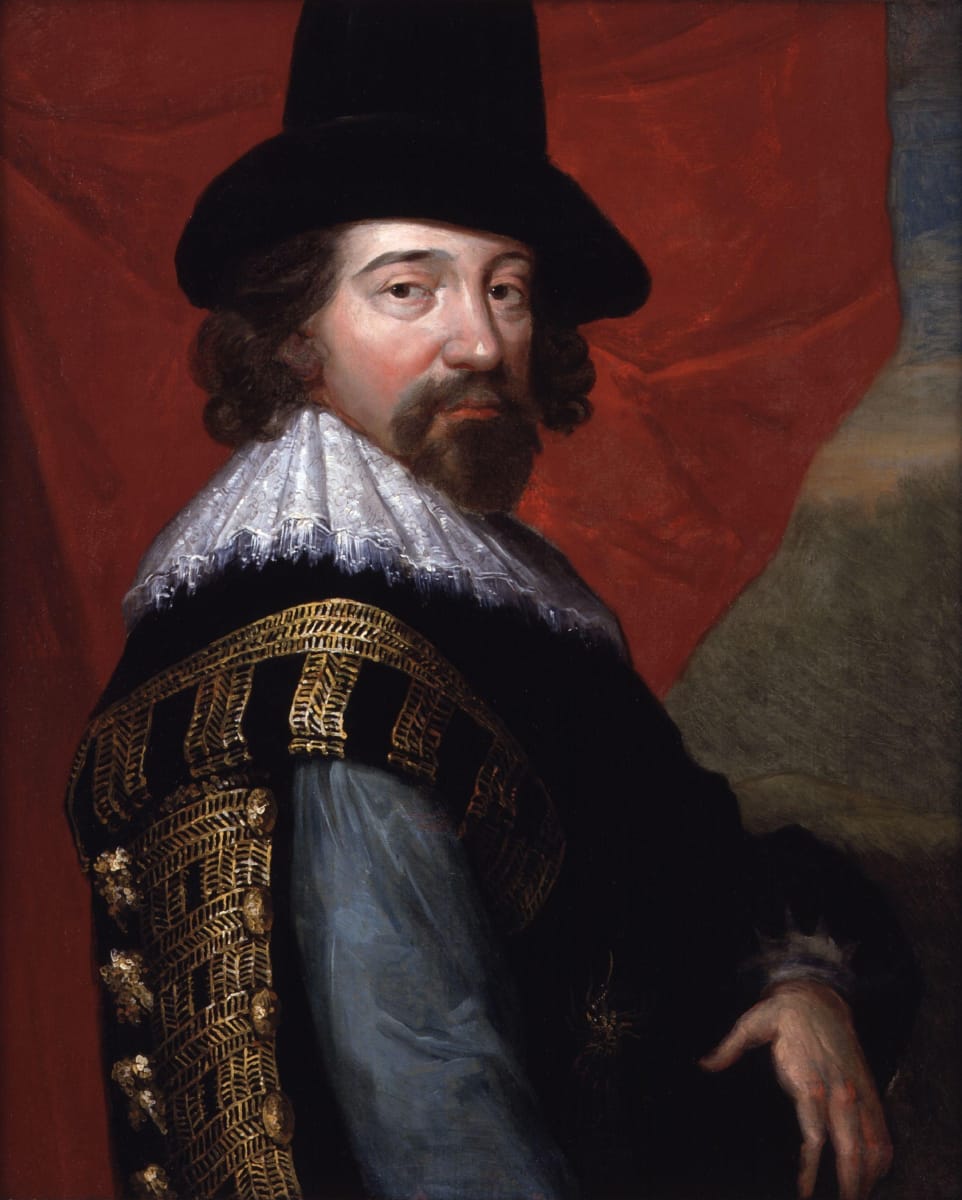 Francis Bacon (1561–1626), was a philosopher, statesman, essayist and literary master, an embodiment of the ascended master Saint Germain. Bacon, who has been called the greatest mind the West ever produced, is known as the father of inductive reasoning and the scientific method, which to a great degree are responsible for the age of technology in which we now live. He foreknew that only applied science could free the masses from human misery and the drudgery of sheer survival in order that they might seek a higher spirituality they once knew.
“The Great Instauration” (meaning the great restoration after decay, lapse or dilapidation) was his formula to change “the whole wide world.” He first conceived of the concept as a boy, and when he later crystallized it in his 1607 book by the same name, it launched the English Renaissance.
Toward the end of his life, Bacon was persecuted and went unrecognized for his manifold talents. He is said to have died in 1626, but some have claimed that he secretly lived in Europe for a time after that. Triumphing over circumstances which would have destroyed lesser men, his soul entered the ritual of the ascension from the Rakoczy Mansion, retreat of the Great Divine Director, on May 1 1684.
Who Is Saint Germain?

Saint Germain is our immortal friend and brother. As the Chohan of the Seventh Ray and Hierarch of the Aquarian Age, he is leading the people of earth into a new era of freedom and enlightenment.
At the time of Atlantis, Saint Germain served as a high priest and a master of invocation at the Temple of Purification.
Through invocations and his boundless love for the flame of Life, Saint Germain sustained a pillar of fire, a veritable fountain of the violet flame, which magnetized people from near and far who came to be set free from binding conditions that afflicted their body, soul and mind.
These devotees achieved physical and spiritual healing through the offering of invocations and the practice of seventh-ray rituals to the sacred fire.
In the book Prayer and Meditation by Jesus and Kuthumi Elizabeth Clare Prophet writes in the chapter titled “Who is Saint Germain?”:
The ascended master Saint Germain is the sponsor of America and the very living Spirit of freedom to every soul. Just as Jesus stood as the open door to the attainment of the christ consciousness in the two-thousand-year Christian/Piscean era, so Saint Germain comes today hand-in-hand with the Prince of Peace as the ascended master of the Aquarian age.
He ordained us, messengers of the Great White Brotherhood, in order that the true teaching of Jesus Christ might be brought to our remembrance, as he promised, by the Holy Spirit who comes in the person of the ascended masters speaking the word of the lord through the messenger.
The understanding of your opportunity to know the self as christ is the true science of religion which Jesus taught to those with “ears to hear” and which Saint Germain now declares to all through “his servants, the prophets.”
Saint Germain comes forth in this “time of trouble” which marks the moment of the turning of cycles from Pisces to Aquarius. His is the consciousness of freedom, the fiery baptism of the Holy Spirit christening a new race, a new life-wave, a new age of self-discovery, and the “new world” America.
America was founded by the brotherhood on the matrix of the original thirteen of Jesus Christ and his apostles. it is a country where freedom of religion, freedom of speech, freedom of the press, and freedom to assemble are meant to provide the foundation for the attainment of the collective Christ consciousness. It is destined to be a community of the Holy Spirit, a forum where the greatest souls of all ages will be “born again” with the incoming avatars of Aquarius to produce a living archetype of freedom. By the unseen hand and the very specific guidance of the ascended masters, America—the heart, the mind, the soul of a world—was born.
You can read more about Saint Germain’s sponsorship of the USA in the section called “Mystical Origins of the United States of America,” in the book Saint Germain On Alchemy.
In this video, at an event in Australia, Mrs Prophet tells of her first encounter with Saint Germain and how the violet flame changed her life. The violet flame has some amazing properties. We hear Mrs Prophet’s testimony of how she has used the violet flame to transmute negative karma, starting with this life and going back into previous lives.
Are You a Keeper of the Flame of Life
Without Knowing It?
What is the Keepers of the Flame Fraternity?
 The Keepers of the Flame Fraternity was founded in 1961 by Saint Germain as an organization of ascended masters and their chelas who vow to keep the flame of Life on earth and support the activities of the Great White Brotherhood in the establishment of their Community and Mystery School and in the dissemination of their teachings. Keepers of the Flame receive graded lessons in cosmic law dictated by the ascended masters to their messengers Mark and Elizabeth Prophet.
Purposes
El Morya speaks of the purposes of the fraternity:
In January 1961 I authorized the formation of the Keepers of the Flame Fraternity to be formed of a circle of devotees within The Summit Lighthouse who would give supreme allegiance to the flame of Life and to the Knight Commander, Saint Germain. I invited all who would pledge their support to this hierarch of the Aquarian age to participate in a worldwide endeavor to draw into the flame of the Holy Spirit sons and daughters of God who would come forward to claim their inheritance as joint heirs of the Christ consciousness….
To those who would give their support shoulder to shoulder to the Ascended Masters and to our Messengers Mark and Elizabeth Prophet for the promulgation of authentic teaching delivered unto them by the hierarchy, a special invitation was extended by the Knight Commander and me to affirm their sponsorship and their commitment by joining this outer fraternity of the Great White Brotherhood….
Those who responded are those who understood from deep within the soul the need to reconsecrate that flame through daily invocations and decrees made in the name of the I AM Presence and the Christed Self of all mankind—those who were eager to pursue the alchemy of the Spirit and to work directly with Saint Germain to precipitate the foundations of the golden age.
Saint Germain A Champion of Freedom
Morya speaks for the sealing of the fires of freedom in the will of God!
I AM the champion of Saint Germain! I AM the champion of freedom! And I come with a momentum of the will of God and of all who combine and serve in the ray of blue and of heaven’s will in order to ratify all that has been given by the Knight Commander.
I stand before you to pledge anew my light and the diamond of my light to Saint Germain, our Commander of Freedom!
“Let the Fiat of the Lord Be with Me!”
Legions of Aquarius Invade Planet Earth
I AM Saint Germain, Knight Commander of the Keepers of the Flame Fraternity!I call you, my Keepers of the Flame, to give accounting before God this day that you might rise in full dominion of yourself, your household, your city and planet.
Onward unto the victory of Aquarius!Hosts of the Lord, march!We have come and we are here to stay![54-second standing ovation]
BELOVED SAINT GERMAIN DICTATION – December 30, 1990
Dictations by Saint Germain
December 19, 1958 | September 19, 1958 | January 20, 1961
January 1, 1984 | April 22, 1984 | April 29, 1984 | July 6, 1984
SEARCH PEARLS OF WISDOM ARCHIVES
The Summit Lighthouse®
Ascended Master Library
The Gold Mine Is Here
- Over 1300 lectures by Mark and Elizabeth Clare Prophet on angels, auras, healing and more
- Over 4100 dictations by the ascended masters on the spiritual path and how to attain your mastery
- Spiritual songs to the angels, ascended masters and hierarchs of the nature kingdom, violet flame, protection and healing decree services for your devotions, chakra alignment, karma balancing, aura cleansing and anchoring peace on the planet!
- Search by ascended master, date, category and more.
The Archives
For additional information please visit the Summit Lighthouse website. Learn how to become a Keeper of the Flame.