LECTURE: Introduction to the Christian Mystic, Saint John of the Cross, June 13, 1976
An Introduction to the Christian Mystic,
Saint John of the Cross – June 13, 1976
Saint John of the Cross-a Very Real Keeper of the Flame Who Caught the Flame of the Brotherhood, Its Teachings and Initiations. Saint John of the Cross Was a Profound Contemplative, Theologian, Poet, Reformer, and Administrator. The Perfect Fusion of Peace and Power in Saint John of the Cross. Saint John of the Cross Is One of the Outstanding Saints of the Western Tradition. This lecture was given by the Messenger of the Great White Brotherhood Elizabeth Clare Prophet on June 13, 1976 in Maui Hawaii.
Video Content and TImeline
00:00:01 Opening Title, Song 60, “Jesus, Master Divine”
00:00:21 Lecture Begins, Living Flame of Love – Saint John of the Cross
00:27:59 Teaching and Reading of St John of the Cross’ Poem, The Dark Night
01:20:15 Mark’s Communion invocation
01:23:07 Meditation music for dictation by Jesus, Song 60, “Jesus, Master Divine”
View the Summit Lighthouse decree and song books CLICK HERE
LECTURE TRANSCRIPT
Christian Mysticism: Saint John of the Cross
We’re going to talk about Saint John of the Cross, a very real Keeper of the Flame. How many of you have read his writings? Patrick, can’t see whose bodies belong to those hands over there, but the reason I wanted to talk about Saint John of the Cross is because he really caught the flame of the Brotherhood and its teachings and its initiations. And he caught that flame by his own inner communion with God, by the way life shaped his life. Many of the saints of the Catholic Church give to us their charting of the path of the ascension, and the path to sainthood. It is a legitimate path. Saint Thérèse of Lisieux said from the time she was a child that she wanted to be a saint. When we hear someone saying that in this time and day, we think of them as having a martyr complex, or some kind of a psychological complex. It is almost not only unpopular but unhealthy, to want to be good, to want to be God.
I mentioned to you I was reading the Satanic Bible because I think it outlays many of the choices of the left-handed path. Aside from the incantations on death, the destruction of enemies, on the fulfillment of sexual gratifications, and et cetera, it uses incantations that supposedly are from the Enochian tongue. And as I looked at that Enochian tongue, I saw that it was the language of the fallen angels. And it’s a very jagged, discordant type of a language. But the essential discovery of the Satanic Bible, the grand conclusion that Anton LaVey attempts to startle the world with, is the fact that he has discovered that man is God. So you see how subtle the differences are between the right- and the left-handed path. We make the same declaration. God makes the same declaration because there is no difference between yourself and God, except your self-awareness of God. Yet, there are many people on the path within the churches of East and West who could not possibly admit the self-identity of God.
When I was a child I was taught to believe that I was made in the image and likeness of God, and whenever I heard that statement I always thought, well, if I’m made in the image and likeness of God I must be God, because there’s no difference between the person and the reflection. But I talked to hundreds and hundreds of people who could not see that. And to go‑-to make that transition to take that next step was blasphemy to them.
And so I realized that in order for me to think my independent thoughts I had to withdraw from most of the churches of organized religion. Reading that Satanic Bible and realizing that the entire Christian world against Satanism is against it simply because of that fact, that Satan declares himself to be God. You can see why the same Christian world would declare that we too are of the devil, that students of the ascended masters are of the devil. The difference is very slight. It is that razor’s edge. The Satanist declares that the carnal mind is God. The ascended master student declares that the flame within is God and that the soul has the potential to become one with that God.
The Satanist exalts the pleasure cult, he knows no barriers, he has no conformity to a cosmic code, he has not the goal of the ascension, his goal is leading the good life. He wants to maintain the status quo of the human consciousness and the human evolution. The ascended master student desires to be cut free, to transcend karma, rebirth, and his goal is union with the one flame, the one life. Now, Saint John of the Cross also caught this vision. And this concept of wanting to be good or wanting to become a saint is a desire that is not only legitimate but necessary. You cannot become what you do not desire to become. Your desire is the spring that releases the energy that causes all of the atoms of your being, your subconscious to come into alignment with that desire.
We create ourselves. We drop into our subconscious like pennies in a pond. We drop into our subconscious our desires, and one by one life takes us through these experiences whereby these desires are fulfilled. When we start desiring to be God, then our lives radically change because within us we have the propelling force of the desire body that is bringing us into circumstances to fulfill that desire. So free will is paramount and we create ourselves.
When Jesus said, “Be ye therefore perfect even as your Father which is in heaven is perfect,” he established the unalterable truth that perfection is possible of attainment. We understand that our God is a transcendent God and that he is continually transcending himself. So there is no ultimate in the cosmos. There is no ultimate in attainment and the goal of perfection is a receding goal. Contrary to what we may think, perfection is possible in this world. It is possible to do many things perfectly in a certain level of the manifestation of perfection. Having attained this we may not be satisfied with that perfection; we may desire a transcendent perfection where the goal becomes more precise, more exacting. And so perfection is at once a present possibility as it is a receding goal. So the desire to be perfect, the desire to be good, the desire to be the saint, the sage, the ascended master, is a legitimate desire. We need not have guilt about it, feel condemned or feel ridiculed because we must come apart from the mass consciousness to champion such desires.
Saint John of the Cross was one saint who had this desire and who had the courage of his convictions. He was a profound contemplative, theologiate and poet‑-a theologian and a poet and at the same time a busy reformer and administrator. To me he was the perfect fusion of the peace and power to which the Elohim goaded us last evening. In spite of severe trials his life was one of complete dedication and deep inner peace and happiness. His trials were very severe. Out of the intense experiences in his life Saint John gathered material for reflection and the ultimate construction of his mystical teaching. He lived as an example of all that he taught as the mystical way; perfect union with God through love. This is to me why he is the outstanding saint, one of the outstanding saints, of the Western tradition.
Why his teaching is easily understood in terms of Eastern mysticism, it is because at the very core of his mysticism is love, indeed there can be, there is no mysticism without love. Love includes in itself suffering as long as it is in this plane. And this is one of the very careful facts of the existence of love; if we are not willing to suffer, then we are not willing to love. Many of the Catholic pictures depicting Mother Mary show a sword in her heart at the same time that they show a flame. The sword piercing the soul of the Mother. This was the prediction at the time that Jesus was brought into the temple. It was seen that he would be manifest for the judgment of Israel and that he would pass through the crucifixion and it is written that the one who observed this turned to Mary and said, “And a sword shall pierce thine own soul also.”
So the piercing of the soul and the piercing of the heart is part of the mystery of love. And when we take on the love of God and the love within our hearts it becomes a burning, transmutative fire. It becomes a vortex so intense that it whirls as the fire infolding itself which Ezekiel observed. Now this vortex of energy, whirling in its center, the more intense it becomes, the more it magnetizes like a whirlwind, almost like a tornado, everything around itself into the flame. When we then call forth an intense light of any virtue of God, that light will draw to itself energies that are diametrically opposed to it.
Why is this so? It is because the core of all creation is God, is fire, is sacred fire. The white-fire core of the atom can never be tampered with. That which is misqualified is the space between the electrons, the spheres around the core, but the core is an energy field of Spirit in matter. It is the Alpha to Omega. It is Father-Mother. That energy is God and remains God. But it is imprisoned in the matrices of hatred which mankind have encased about it. True love means that we love that light and that love that is in the center of the atom enough to be willing to tangle with the hatred that surrounds it. This is the meaning of God being crucified in matter. God is encased in a mold of limitation, of our prejudices and our prides, our jealousies, our greed, our selfishness. We superimpose our energy because we have free will and we are cocreators. We superimpose that energy upon this nucleus. So the soul that truly loves God is here to set energy free, and that’s what you are doing when you give invocations.
When your heart becomes strong enough, fired in love, your heart will also be pierced. Because you become a vortex, a crucible, for the planetary body like the Bodhisattvas of the East, and you become the vortex which draws by a tremendous magnetism, these misqualified energies of the planet. So wherever you have an altar and you erect the flame you will have two factors of magnetization. You will magnetize tremendous energies of the Central Sun and from God, at the same time this energy is expected to be held and focused by you to consume the darkness of the earth.
Saint John of the Cross perceived this. So did Kahlil Gibran. He speaks of the pain of love and the suffering of love. It means having that energy and receiving also the hatred of the world. Hatred that seems personally directed against the person but is always directed against the light which you carry. It is really impersonal but it becomes personal because you have chosen to make God personal where you stand.
There are many souls who come into the teachings of the Brotherhood, or see the path of sainthood, and their first contact with it after many years of searching is one of great joy and happiness. They have found the flame. Like coming to a crystal waterfall in the mountains. They dance and play in the cool, clear waters. But once they begin to build the momentum of fire they realize that it is a tremendous responsibility.
Saint John had the true love of experiencing the dark night of the soul, which he thoroughly described, and watching others around him going through the dark night and realizing that they had not the least understanding of what they were going through and worst of all, their teachers, the brothers, the priests, and the nuns in the Catholic church of his time hadn’t the faintest idea of how to counsel people going through the dark night. And this great tragedy, to him, made him give his life to the reform of his order as well as to the setting forth of the teaching on the dark night.
He was born in fifteen forty-two, Juan Dieppes Y’Alvarez, in a small town located in the central plateau of Old Castle, Spain. His father died after his birth, leaving his family in extreme poverty. He went to an orphanage school, he was chosen to serve as an acolyte at the convent, and in addition to his elementary studies, he became an apprentice to a local craftsman. At seventeen he began to do work in a hospital and then he enrolled in a Jesuit college. He received a foundation in the humanities, preparing for the great works that he was to set forth in writing of his mystical experiences.
At the age of twenty he entered the Carmelite Order. He studied philosophy and theology at Salamanca, and at the Carmelite College he was an outstanding student and was appointed prefect of studies. He was ordained in fifteen sixty-seven, traveled to Mendina, and met Madre Theresa, the wonderful saint, Mother Theresa of Avila. They held the polarity of the light of the Father-Mother God for their time, and they worked together. They prayed together, and they both realized the weaknesses, the limitations, the confines within the church that were the result of applying the law and certain perversions of the law without the spirit, which John came to call the living flame of love, and he wrote a poem by that name.
Now Saint Theresa was already involved with the restoration of primitive rule which she called the reform within the church. And John confided to her that he longed to embrace the life of the contemplative, the contemplative in deep solitude and prayer. He began a reformed community of Brothers embracing this predominantly contemplative life. And this community became known as the discalced Carmelites. Discalced means barefoot. Their active work consisted in preaching and hearing confessions. The new order spread so quickly that it became a threat to the existence of the old order. And so the old order resolved to suppress the reformed houses that John had founded.
This is the beginning of the persecution of the flame of love, the piercing of the heart of the saint. For refusing to renounce the reform he was imprisoned. Fra John was led to his prison cell, a little room originally intended as a closet. It had no window. It was frightfully cold in winter, suffocating in summer. Three evenings a week he had to eat kneeling on the floor in the middle of the refectory. When the friars were finished their supper his shoulders were bared and each member of the community struck him with a lash. It is hard for us to imagine and yet not so hard. We think that brothers in a community would not have this energy within them and yet we are brothers and sisters in the community of the world and we see every day man’s inhumanity to man.
In a manner some declare was miraculous, he managed to escape. The years that followed his imprisonment were for Fra John busy but comparatively calm. He gave much time to prayer and to administration and during this time he completed most of his writings. His writings are not evolutionary in nature but they all embody his final understanding of God that he attained through his experiences. Many writers, we find, have periods of writing and one can trace the evolution of their understanding. Not so with John. It is almost like the Book of Revelation that was revealed to John the Beloved. Complete, intact, a theology for this part of the path that we all must go through. Now, I’m going to start talking about this path and I think that at all of you will recognize that you have been involved in some part of this path but did not understand it as such.
He was sought out as a spiritual director. He was liberal with his time. He guided his fiars and nuns and many lay persons. Toward the end of his life his calm was disturbed by a clash with his reformed order. For the first time he was not elected to any office. He was denied the very order that he had founded. Much in the manner of Saint Francis. Saint Francis died with a broken heart, considering that he had failed. He founded his order based on poverty and while he was away in the Near East and on pilgrimages, his brothers got together and decided that they should have ownership of buildings and libraries and books, and that the order should be reformed. It was agreed to, agreed by the Pope, he returned. He could do nothing about it. He went into the mountains and prayed. He had his vision of Christ and he did receive the stigmata but he died feeling his failure because those that surrounded him put him out of that very order that he had founded.
And so it happened to Saint John as well. John was sent into solitude where he became seriously ill. He sought medical attention in U, Ubeda, and the Prior, who had a particular aversion to him because of of his reputation for holiness, assigned him to the worst cell in the monastery. Prior to his death they forgave one another, embraced one another, nevertheless he died having fulfilled the favors that he had asked of God: not to die as a superior, to die in a place where he was unknown and to die after he had suffered much.
I don’t know if you have ever been ridiculed by your families because of your desire to be with God, to pray, to fast; but perhaps in some small measure, for your understanding of God you have also felt the hatred. Holiness and the desire for holiness is an unwanted commodity in this world. When you understand that everyone who has ascended from this plane and who has become one with God has attained the liberation, has had to go through this. As Jesus said, he said that we would be persecuted for his name’s sake. When we realize that we are not unique it makes all the difference on the path.
You know Ramakrishna had no understanding in his outer self of who he really was. It is said that the avatars who come, if they really know who they are, they would not stay. And so even to their outer consciousness there is the veiling of the God which they are manifesting and bringing forth. And so Ramakrishna went through all kinds of periods of intense manifestations of the awareness of God in many, many aspects, and many times he would be overburdened with sorrow and be troubled because he did not understand if what was happening to him was legitimate, was really within the framework of one’s soul’s evolution toward God. A woman came to him who knew the scriptures and all of the traditions of the saints of India, knew them well, the Bhairavi (or the Bhaivani) and she was with him for a number of years and each time he went through one of these periods she could explain to him that yes, it was in keeping with tradition and with scripture and so he could go on in his exalted states of consciousness At long last he came to the place where she felt that she was his teacher and desired to control him so she kind of was put to the background or the backdrop of his life, but they also ended in mutual forgiveness and love.
But the one thing that marks the true saint on the path is a childlike quality of innocence and almost a helplessness when the soul really becomes so filled with light as to be sheer spirit in matter that one seems to manifest qualities of absentmindedness, forgetfulness, helplessness, you’ve heard of Ananda Moyi Ma, the saint of India who focuses the flame of Mother. She has no desire to eat. Her disciples feed her. They have fed her for many years to keep her in this plane. They dress her, they comb her hair. She is so involved with God that the practical matters of matter have dissolved from her.
Now this level of attainment is beyond the level that we speak of here with Saint John of the Cross. He is really speaking to disciples who are the real disciples on the path, who, once having gone through these periods of the dark night, will come to those levels of God consciousness which in the East are called samadhi and intense activation of bliss. The early privations, the misunderstandings, the imprisonment of John in his final persecution, were a part of the set in the drama that he played, part of the stage that the Great Dramatist arranged to wean him from outer attachments.
When we look at our lives and our surroundings and consider that we have had problems, sufferings, encounters that we would not consider a part of the good life or the general happiness that mankind seek, we must realize that these are from a God who loves us, who chastises us, who allows our karma to descend, because he sees that we are able to come to grips with it, and all of this is not to create the hardened cynic but to soften the heart, to mellow the heart in its love for God. And so these brought about a transformation an enlightenment, a purification, gave him a great love of others, a deep understanding and compassion for the sufferer, and an uncommonly clear vision of the beauty of God’s creation. He was impressed with the pains of poverty, he sought to help those who were afflicted, he always took care of the brothers when they were sick, we would cook for them himself. If they were doing menial chores he would join in. He was certainly the soul of humility. He also was quick to come to those who were sad and depressed and whenever he gave admonishments which were necessary he would never allow a soul to leave him with a state of depression or a feeling of hopelessness or that the soul could not rise. He loved nature a great deal and loved all creatures. He also was a vegetarian. [pause]
In his Prologue to the ascent of Mount Carmel he says, “Some people, and it is sad to see them, work and tire themselves greatly and yet go backwards. They look for perfection in exercises that are of no profit to them but rather a hindrance. Others continue to make fine progress in peace and tranquility. Some individuals encounter an encumbrance in the very consolations and favors God bestows on them for the sake of their advancement and they advance not at all. We will also discuss many other experiences of those who walk along this road. Joys, afflictions, hopes and sorrows. Some of these originating from the spirit of perfection, others from the spirit of imperfection. Our goal will be, with God’s help, to explain all these points so that everyone who reads this book will in some way discover the road that he is walking along and the one he ought to follow if he wants to reach the summit of this mount.”
The summit of Mount Carmel is the summit of the attainment of perfection. And Saint John defines perfection as the state of perfect union with God through love. These could easily be the words of an ascended master.
“To love,” he says, “is to divest and deprive oneself for God, of all that is not God.” And thus he is confirming that God is within the self, that God is the self. And that pure love is that which is willing to be stripped of all that is less than God. How many of us can contemplate that goal and can appreciate what it takes and the sacrifices each day.
We can never judge by people’s outer actions whether or not that love is truly the love of God. We may see some people doing very silly things. We’ve seen saints dancing around, they may eat or they may not eat. They may fast, they may not fast. They may be vegetarians, they may not be vegetarians. It is not really in what people do in the outer but the motive, the manifestation, where the flame is, where the consciousness is. This is why the friars were able to very easily flagellate John because they held themselves as the judge of his consciousness by his actions. We cannot judge people entirely by their actions. We must observe motives and even then never can we be the judge because God is the only judge.
His writings are extensive but the mystical doctrine of Saint John can be expounded in a few words. He has but one idea, the road leading to God does not entail a multiplicity of considerations, methods, manners, and experiences. Though in their own way these may be a requirement for beginners. But demands only the one thing necessary, true self-denial, exterior and interior through surrender of self. It’s interesting that he did not say, “The path demands for only one thing, the one thing that is necessary is love.” He didn’t say that. He said “True self-denial exterior and interior through surrender of self.” These lead to that perfect love which casts out fear. But in the name of love many people can include within their consciousness every manner of self-indulgence.
I’d like to read you his poem. “The Ascent of Mount Carmel” or “The Dark Night of the Soul.” It has eight verses. It is the setting forth in a poem of the mystical experience of this disciple of Christ. And the mystical experience is there for us to experience, for us to glean from the poem. If we have not experienced the same mysticism, we really cannot understand the poem, although the words be simple, the words are keys to the experience.
He is so concerned that we will not understand the poem that he writes an entire book to interpret the poem. [Laughter] Very sweet. Very loving. He wants to be sure that we make it on the path. He knows that we don’t have teachers and advisors who will show us the way. And so he has written all of this. These are the collected writings of Saint John. Seven hundred pages. And you know, when you read this book, you can’t extract‑-I like to underline when I read the salient points and then teach from them. You wind up underlining the whole book. So I hope that by this mini-lecture on his consciousness, I will goad you to pursuit of it.
I would like to say that when we talk about self-denial we have an intense reaction from the carnal mind and the enthroned carnal mind among the intellectuals of the day. Even the new age teachers, teachers of East and West, teachers that come out of India professing to be gurus and so forth, to satisfy the intellectuals and the freethinkers and so-called liberals, they will teach a doctrine of anything goes. No path, no rules, no way that can be carved out. But anything you do, as long as you’re getting somewhere in your self-expression, is okay. In other words, it’s the opposite of self-denial. So there are really two very opposing paths that are prominent in the world today and I would say the path of indulgence is far more to the fore and attracts millions more than the path of self-denial.
There are many people who are looking for an excuse to be on the Path, an excuse of a path that is not the real Path. And they go to a great extent to evolve an intellectual philosophy that includes in itself this concept of self-indulgence in one form or another. So this is a very unpopular doctrine and it is no wonder that only a few of you have ever even encountered this path. It is not even popular within the Catholic Church. It is not popular because this is in a world where really Satanism is the established doctrine and the established order. Christianity is not. It has been lost centuries ago. Buddhism is not. It has been lost centuries ago. Interestingly, however, with the entering into the church of these doctrines of self-indulgence we have a mass exodus of the faithful and lightbearers, who sense that darkness, who want no part in it, and who go to the hills to find God. Here is his poem, then.
One dark night, fired with love’s urgent longings
Ah, the sheer grace. I went out unseen, my house
Being now all stilled. In darkness and secure
By the secret ladder disguised
Ah, the sheer grace. In darkness and concealment
My house being now all stilled.
On that glad night in secret, for no one saw me,
Nor did I look at any thing with no other light or guide
Than the one that burned in my heart
This guided me more surely than the light of noon
To where he waited for me. Him I knew so well
In a place where no one else appeared
O Guiding Night, O night more lovely than the dawn
O night that has united the lover with his beloved
Transforming the beloved in her lover
Upon my flowering breast which I kept holy for him alone,
There he lay sleeping and I caressing him
There in a breeze from the fanning cedars
When the breeze blew from the turret,
Parting his hair, he wounded my neck with his gentle hand
Suspending all my senses I abandoned and forgot myself
Laying my face on my beloved
All things ceased. I went out from myself
Leaving my cares forgotten among the lilies.
In the ascent to perfection the soul passes through what Saint John describes as the dark night. Our dark night is the passing through the labyrinth of our karma, the facing of our human creation that almost completely obliterates the light of the Christ and the light of the Presence. We walk as in the dark, groping. We cannot see. We grope our way only by faith, knowing that if we keep on keeping on we shall arrive.
There are three reasons that John gives for calling this journey toward union with God, a night. The first has to do with the point of departure because the individual must deprive himself of his appetite for worldly possessions. This denial and privation is like a night for all his senses. His senses are blackened out. He is no longer able to experience through these senses. He no longer derives happiness through these senses or any joy or any fulfillment. He remembers how it used to be when he was in the world and he could experience the things of the world that brought him joy through the senses. Now none of these bring him joy and so he is in the night when the senses are turned off. Pushing him within to experience God without the perceptions of the senses.
The second reason refers to the means or the road along which a person travels to this union. This road is faith. And for the intellect faith is also like a dark night. The intellect is always demanding reasons why, always putting questions, always curious, always constantly taking the knife of the intellect and carving up into minutia the details of this world ad infinitum, ad nauseam. But the walk to God is by faith. It has no explanation except the soul within longing to be one with the Great Lover.
The third reason pertains to the point of arrival, namely God. And God is also a dark night to man in this life. Reaching very high states of God consciousness we come out of them not knowing who we are or where we are. This has been my experience because there is no coordinate in time and space to which we can relate this union with God. Seeing the masters, seeing the saints, feeling their radiation, being caught up in the rapture of their presence, being caught up for hours at a time in this rapture; to come out from it, to be in it and to be in the world is like a dark night. Where is the point of relativity?
One of the first experiences I had of this infinity of God and the self swallowed up in it, I was caught up into a plane where I suddenly saw myself and I experienced that I was breaking through as it were, the level of the clouds, as one does when flying in a plane. And I broke through the clouds and all was stillness, the stillness of an immensity. And the clouds went on for an infinity and it was a twilight and there was no one else there. No one else at all. It was an entire cosmos, simply an immensity. And for me to enter it I had to go alone into it. And entering into this vastness was almost like a night because it was the total stilling of all existence as I had known it previously. No one. No thing, to relate to. But simply the immensity. And the thought comes to the soul, shall I withdraw? And there is that moment of decision, shall I turn back, shall I go on, shall I pursue this course uncharted? That is what it is. Uncharted. Though the saints have written to us about it, when we have the experience we have the sense that there is no one there.
Jesus on the cross cried out to his God, “My God, my God, why hast thou forsaken me?” Some people on the path, metaphysicians, have denied that he said this, for he could not say this for God is always present. They have not understood another phase of the dark night which comes beyond the dark night of the soul and the dark night of the senses. It is called the dark night of the spirit. It is the place where we have passed a good number of initiations on the path and the attainment of those initiations anchored in the heart, we are given the supreme test that Jesus had on the cross. And the test is to sustain God and God self-awareness without any reinforcement from God, from the masters or from the angelic hosts. Part of that test was in the garden when Jesus was alone. The disciples fell asleep. Not until he had surrendered to the will of God did an angel come and minister unto him.
While we are yet fledglings and children, the masters come to reinforce our faith, our hope, and our charity. When we become living masters before the absolute ascension we have that darkest hour of the darkest night of the spirit. On the cross during the crucifixion the soul is totally cut off from the I AM Presence; totally cut off from every other soul who has ever attained perfection. By the light and solely by the light that has been anchored in the chakras, that soul must make it through the crucifixion and through the raising of the body. In the moment of being cut off, when one has been so close to God, has lived and moved in God, in that moment of being cut off, suddenly to feel the light of the Presence withdraw is an agony beyond all agonies. There is no other like it.
I recall in a small way the disciplines of the masters, the disciplines of El Morya, withdrawal for a certain number of hours and that withdrawal even of the guru from the chela is such an intense suffering, it is the tearing away of the lover and the beloved. The tearing these apart when they are already one in body and soul and mind. And so this is an experience that tests our love of God, that we love God enough that we can sustain that flame and go through the dark night and go through the suffering and then be reunited in the permanent marriage, the alchemical marriage.
The mystical way, the three states or ways of spiritual exercise known as the purgative, the illuminative, and the unitive. These three which we have just discussed. The deprivation of the senses, the purgative, this purges us of our desires for this world. The illumination is the replacement of the intellect with the Christ mind through faith, and the unitive when man comes to that place of uniting with God.
The first way or night is the lot of beginners on the path. It is called the dark night of the senses, the purgation or mortification of the appetites. The soul that journeys to God but does not shake off its cares and quiet its appetites is like one who drags a cart uphill. Appetites deprive the disciple of God’s spirit since the love of God and attachment to creatures are contraries and cannot coexist in the same will. Now it says, attachment to creatures. This does not mean that we cannot love one another. It means that our love for one another must be an intense love for God and not a possessive love. As soon as we have possessive love we desire to be possessed and to possess others, to be controlled and to control, we find ourselves far afield from the center of God’s love. And the two states of consciousness are incompatible.
The appetites weary, torment, darken, defile and weaken the disciple. I have seen this happen to those who have tried the spiritual exercises as a means to God, thinking that in sacrifices and in spiritual exercises they could attain union. But not being willing to rid themselves of the appetites. They have sought sacrifice as the substitute for obedience and the Prophet Samuel made very clear to Saul that obedience is better than sacrifice. We may go through a life of sacrifices such as waiting on our fellowman night and day from morning till night or sacrifices of rituals and oblations, or sacrifices where we sacrifice the Christ in ourselves for family and friends. And we may imagine that these sacrifices are the Path. But they are not the Path. The Path is conformity to the will of God. And possessiveness is not that conformity.
“Appetites are wearisome and tiring to a man. They resemble little children, restless and hard to please, like thorns the appetites wound and hurt, stick to a person and cause him pain. A man’s intellect clouded by the appetites becomes dark and impedes the sun of either natural reason or supernatural wisdom from shining within. One inordinate appetite alone suffices to make a soul so captive, dirty and unsightly, that the soul is incapable of conformity with God in union.”
John is not trying to engender shame or guilt or fear or control. All of these qualities we have attributed to the perversions within the church. He is stating facts of the law of the path and we cannot go around these facts. We cannot allow ourselves to be deluded into thinking that they do not exist. Appetites sap the strength needed for perseverance in the practice of virtue. Because the force of the desire is divided it becomes weaker than if it were completely fixed on one object.
A man enters this dark night of the senses in two ways. He begins by renouncing any sensory satisfaction that is not purely for the honor and glory of God. Now there are many things, many avenues of individual expression of love in life which we engage in. It is not that these are of themselves wrong. It is our attitude to them, our consciousness as we participate in them. The love of one another, of family, of children, of nation, of community, and service within it need not be a manifestation of uncontrolled appetites. It may be the very fulfillment of the burning love of God that is in us. But one thing is certain, that if we want to be on the path God will show us the integrity the honor of the path and we will know within ourselves when we are engaging in these activities for the glory of God or for the satisfactions of selfishness.
A man enters a dark night then by renouncing the sensory satisfaction that is not purely to the glory of God. He brings his life into conformity with the life of Christ. He must therefore study the life of Christ in order to imitate him. For this purpose Saint John would withdraw to hidden parts of the monastery to study his Bible, his most treasured book. Once when he and his brothers went to a town where there was someone who was a notable ascetic that had manifestations even in his body, John did not go out to see. He had no need of outer witnessing or convictions of the inner life. He withdrew to read his Bible and to commune with the life of Christ.
In the second night, the dark night of the spirit, the spiritual senses are darkened in order to journey to God the intellect must be perfected in the darkness of faith. The memory in the emptiness of hope and the will in the absence of every affection. Only faith, hope and charity can unite the soul with God in this life. So in the darkness of faith we exchange the human mind for the divine mind. The divine mind that is the all-knower instead of the human mind that is the all-questioner. The memory is emptied and all that remains within the memory body is hope. Not the sense of injustice, not the sense of self-righteousness, not any senses of memory that tie us up to manifestations, but simply hope.
And finally the absence of every affection, the manifestation of charity. Affection in the sense of loving someone for the purpose of getting something in return. This includes loving God for the sake of reward: We love God because we think we should love him because if we love him he will do nice things for us. That is an appetite. That is an indulgence.
Faith causes darkness and a void of understanding in the intellect. John says, to attain union with God a person should advance neither by understanding nor by the support of his own experience, nor by feeling or imagination, but by belief in God’s being. For God’s being cannot be grasped by the intellect, appetite, imagination or any other sense.
When I think of these words of John, to me it is the concept that between our intellect, our appetites, our imaginations or our sense, we build bridges to God. We think of concepts. We imagine pathways. We think of this and that and the next thing. Now rituals and exercises are necessary at a certain point. But when we come to the dark night anything that is a means to an end is also a means of separation to that end. In other words, I am here. God is there. I need my intellect, my imagination , my senses, et cetera, to get to him. If I have none of these I also eliminate time and space and my love of God is God in me and there is no longer any separation.
To be willing to undergo this, to be willing to know God and perceive God directly as the self takes great courage. It means to have experience in the spherical body and the spherical consciousness. To be willing to walk away from all of the previous modes of finding out God. It’s like the yogis in the East who still all the senses, the eyes, the ears, even the mouth, everything is closed for the finding of God. And the question is do we love God enough to throw out all the established means, all that we have been programmed and educated to use to attain a reasonable equilibrium in this life?
Hope begets an emptiness of possessions in the memory; in the measure that a person dispossesses his memory of forms and objects which are not God, he will fix it upon God and preserve it empty in the hope that God will fill it. This was the great theme of the life of Saint Clare. The vow of poverty was to her the creation of a vacuum that God might fill. To be totally impoverished is to be the poor in spirit. The poor in spirit; with nothing we have the vacuum that nature abhors. And so nature as God will fill the vacuum.
If our memory is filled with the memories of lust and indulgence and the things of this world that we desire to possess it’s like having a full attic. So we have to be filled with hope and only hope. Our souls waiting upon the coming of the Lord. The Holy Spirit illumines such souls. They generally attain to the knowledge of everything.
I would like to confess to you that I have many experiences of my memory and my etheric body being a total blank. Totally blank. Most of the time this happens preceding a conference, or preceding dictations. And when I come to the platform I have to remember to read the program to see what the name of the dictation was because I cannot even remember that. Our programs are dictated by the Darjeeling Council. It is as though God has wiped, carefully wiped from the screen of my consciousness all traces of human experience so that the flow of his Word through me will not in any way be conditioned by human experiences and objects. It gives me a feeling of tremendous helplessness. I have to ask people around me what is going on, what time is it, what am I doing next. And many times I have been burdened with this to the extent that I have thought I must have a very sick memory body, I must be ill, there must be something terribly wrong with me, I must be this terrible sinner.
And these thoughts of self-condemnation are the thoughts that you have when you go through different aspects and experiences of the dark night. I have come to the platform to give a dictation and I could not even imagine what more God would have to say about anything, and all I knew was that God was and that God is. And Mark used to say the same thing and I never understood it until I experienced it. But it is this emptying process, and part of the requirement during my training to be a messenger by El Morya was that for a great extended period lasting for months he forbade me to read a magazine, a newspaper, a book, to allow my eyes to even contact anything of this world in print, or in the movies. And having been a political science major and a student of affairs, and being in Washington, this was a difficult test for me. Because I was concerned with what was happening and what I could do about what was happening. He explained that this memory body had to be emptied.
So you see, without understanding that it is part of the path it can be a much greater agony and truly be a much more than simply the night of the memory, it can be the dark night of the soul in agony wondering why it is functioning in a way that is so unusual and so much apart from the world and the way of average people in the world. This emptying of the memory, as John saw, generally, those who have that emptying attain to the knowledge of everything.
I have found that when I open an audience to questions about the masters that the question itself evokes the response from the masters and if I have never heard the question or considered its answer it is always there, the awareness comes. There are some occasions when the masters choose not to give an answer to certain questions and Gautama chose not to lecture on many speculative subjects because they did not produce any good fruit on the path of self-mastery. In these matters I simply have to say I don’t know, it hasn’t been revealed.
But I do find that one’s ability to trust God for answers becoming a total innocence and a total dependency on God, produces that knowledge of everything that is there when we need it. But certainly I do not carry it on the tip of my mind all the time. I do not know everything the masters have ever said or all of their teachings at this particular moment. I could not remember; they are an infinitude of teachings and understandings. I have to ask someone what the masters said in another conference, or what I taught in another conference, because it is there as a point of infinity when we want it, and it is gone when it is not being used at that moment, so that the memory is empty to be filled by God.
Yet we would achieve nothing by purging the intellect and memory in order to ground them in the virtues of faith and hope. If we neglected the purification of the will through charity. The strength of the soul comprises the faculties, passions and appetites. All this strength is ruled by the will. When the will directs these faculties, passions and appetites toward God, turning them away from all that is not God, the soul preserves its strength for God and comes to love him with all its might.
It’s like the desire body being a gigantic, torrential river with tremendous power. Take that river and create sixteen tributaries, make sixteen trenches and divide it up, and each one of them then becomes a trickle. So that our desires take our strength in so many directions that not any one single act of desiring produces any real thrust for a purpose in our lives. This is what happens when we have a multiplicity of desires. When we have one desire our whole momentum of energy goes toward its fulfillment.
Souls begin to enter the third night when God, gradually drawing them out of the state of beginners, begins to place them in a state of proficience. This state is described by Saint John in the mystic poem which I read to you. These are stanzas which the soul recites, having already reached a state of perfection and passed through severe trials and conflicts. If the portrayal of the afflictions of this dark night in the writing of Saint John prove frightening to some, it is only because he in his deep compassion wished to describe the sufferings so as to exclude no one. This is a portion of his explanation of the poem.
“Oh, what a miserable lot this life is. We live in the midst of so much danger and find it so hard to arrive at truth.”
Now the natural man would disagree with this. The natural man would not say this is a miserable life. He would say it’s a happy life. And he would say he’s having a good time. He would not say there are dangers, nor would he say it is difficult to arrive at truth because his truth is a relative truth. But to the one who turns an about-face and begins to reap what he has sown, he then sees the misery of his ancient sowings. And this is his verdict.
“The clearest and truest things are the darkest and most dubious to us and consequently we flee from what most suits us. In how much danger and fear does man live since the very light of his natural eyes, which ought to be his guide, is the fist to deceive him in his journey to God and since he must keep his eyes shut and tread the path in darkness, if he wants to be sure of where he is going and be safeguarded against the enemies of his house his consciousness, his senses and faculties.”
Did you ever think of your sense both physical and spiritual as being your enemies? With all this talk about ESP, Kirlian photography, and different aspects of the probings of psychics and readings, et cetera, the constant discovering of God and hundreds and thousands of different aspects, all of this comes from the use of the faculties of the spiritual senses or the psychic senses or the physical senses, the stretching of these senses into other dimensions.
You see what an opposite path Saint John is proposing to us. He says not through these avenues but by turning them off do you find God. And so Ramakrishna whom I consider to be one of the greatest of saints of East and West, and I’m certain my consideration is not what is important‑-I’m certain that God considers this also and made him the saint that he was. When people would come to him who were clairvoyant or psychic he would heal them of their clairvoyance and of being psychic. And he would say they were unfit for the path until they were healed. He was saying the same thing that Saint John says. You need to turn off these senses because they are the endless probings of the astral plane that will never, never end.
When you combine the intellect with the psychic you produce the mechanical man that we conceive of as being the Martian. Our children are learning in school that scientists are projecting the development of people upon this planet that have enormous brains, and this tampering with the genes and chromosomes has produced this type of life on other planets. Scientific, highly scientific mechanized man, extremely psychic. The psychic realm is the polarity of the intellect. The two work hand in hand to create the human monster that is so sufficient unto himself that he does not need God.
This is the typical Martian running around the material universe in a spaceship for hundreds and thousands of years, never getting out of the round of rebirth, never attaining liberation or soul mastery but having an intense mastery of the psychic and mental planes and thereby self-satisfied. So intense is their mastery that they can just turn a dial, dial in and out of frequencies and vibrations; you see a spaceship one minute, the next minute it’s gone. Why? Because the eye contact of your being has already registered in the instruments in the panel. And those who are there will simply change the frequency of the entire ship and their bodies and they are out of the line of the narrow spectrum of our vision.
How many of you have seen a spaceship and seen it disappear? It happens all the time. And then you say to yourself, oh, I never really saw it, which is another ray reflecting back to you to cancel out your memory which is also an accomplishment of these mad scientists.
So the matter cosmos, the matter cosmos affords infinite variety and opportunity for endless entertainment, exploration, indulgence, titillation of the senses; it is a never-ending hell. Never ending. So essentially, earth itself today is at that point where we either decide to ascend in consciousness by spiritual mastery or we will become one of these evolutions perfected in science and go on and on and on until finally the merciful God will take his inbreath and all of this creation that has become a madness will be drawn in to the fiery core and imperfect creation is canceled out.
You’ve heard of cloning.: the taking of one cell of you and creating another you. This is being done. It’s been accomplished with lizards. It was done on Atlantis. It’s just a question of time. It affords a tremendous challenge psychologically. If you suddenly saw eighteen of you walking around, would you really know who you were? Or which one was the real you? It’s like “What’s My Line.” The idea is that the wealthy could create twenty or thirty bodies of himself and at any time that he was missing a part or needed a transfusion or a new heart or a new kidney, he could just take one out of one of his clones. These are soulless beings. It is the reproduction of the chalice, the matter form, but no one but God can infuse it with the flame.
So it is the creation of a mechanical creation of robots. It’s nothing new. Robots have been created by scientists in the Atlantean culture and on other systems of worlds for thousands of years. There are many robots inhabiting time and space. The difference between the robot and the man is the flame in the heart. That is the only difference.
The concept of preserving life just before death in a chemical or on ice or in certain‑-a way of preserving the body and bringing it back in a thousand or two thousand years is another exploration and deviation that involves the entrapment of the soul in that body so that the soul cannot continue to evolve in other planes. All of this in the name of science, exploration, et cetera.
So John has this answer: The enemies of the house, his senses and faculties.
“The soul then is well hidden and protected in this dark water close to God. Since the dark water serves God himself as a tabernacle and dwelling place, it will also serve the soul in this way, as a perfect safeguard and security even though it causes darkness to it.”
He also emphasizes the intense happiness that the soul has in going to God.
“The glad night. No one saw me. The flame burned in my heart. O night more lovely than the dawn, the lover with his beloved is united.”
Kuthumi wrote, the Master K.H.,
“In the divine romance the beloved must be seen and known as the reality of the self and love itself must be regarded as the means of transmitting the identity of the beloved into the all-enfolding action in the formless as well as the in the form world. This is the purpose of divine romance and the imitation of Christ is the highest love to which the chela can aspire.”
We must perfect all relationships with God. This is one of the greatest riches and treasures of the Hindu teaching, that we must become the father, the mother, the son, the daughter, the sister, the brother, the husband, the wife, and the lover of God. All of these relationships perfected through many incarnations, we finally attain to the total awareness of the self as God. Ultimately we must become the lover of God as well as God becoming our divine lover. Once you have mastered the flow of energy through the upper chakras you can experience the bliss of the union of the divine lover, the union of your energies of the kundalini in the crown chakra.
Kuthumi warns of the trap concerning the glamour of the divine romance. One may get lost in the bliss of meditation and therefore neglect their karma and their dharma, and this occurs of course in human relationships and in family relationships. We often observe people who are very compatible, and totally caught up in being in love. But we observe that their love bears no fruit in the community. It is a selfish love. They want to be alone. They remain off to themselves. They may have their children or they may be too selfish to even have children. And so their love becomes a love that is turned into possession that ultimately manifests in the physical body as cancer.
Love that is possessive cannot be sustained. It becomes the death of the body. But people mistake that for real love because they get caught up in what is, quote, the “bliss” of that love. We can make the same mistake in our meditation with God. We could get caught up in the bliss. The bliss can carry us off into that perverted peace of which the Elohim were speaking. We lie under the tree and life goes by, and our bliss has become almost the state of a coma.
“In this meditation of the great divine lover the soul beholds the wonder of God as the wonder of his true self.”
In addition to the admonishments and consolations to the soul in the afflictions of the dark night, John reveals a soul in its intimacy with God, a soul on fire with love. He’s described this in his Spiritual Canticle which is too long for me to read to you but is well worth your reading and in the poem of the living flame of love which is short enough for me to read to you.
The spiritual canticle is a love song between the soul and Christ, the bridegroom. When we perform our marriages in our church the consecration of the bride as the bride of Christ, the soul to be wed to the spirit and the bridegroom as the spirit, as the Christed one. And so marriage becomes this never-ending pursuit of two souls on the path for the alchemical union. It becomes an initiation, an integration and a divine ritual of those who are on fire with love and whose fire in the heart merges in that love to become God.
John says that these stanzas were obviously composed with a certain burning love for God. They begin with a person’s initial steps in the service of God and continue until he reaches spiritual marriage, the ultimate state of perfection. In our society for many years, the concept of getting married has been the supreme goal of life. And only recently have people broken the matrix of this being the ultimate. But actually, that desire, that continuing desire for marriage is really reflective of the soul’s intense inner desire for reunion with God. And because it does not know how to attain that union it seeks it in lesser unions and fails to consecrate those lesser unions with the purpose of community. Saint John refers to the mystical way, the three states or ways of spiritual exercise. And that’s the canticle which I will not read to you because it is too long.
Now here is the “Living Flame of Love”:
“O living flame of love that tenderly wounds my soul.”
If you were writing of the flame of love would that be your first words?
“That tenderly wounds my soul”‑-
“. . .in its deepest center. Since now you are not oppressive. Now consummate if it be your will. Tear through the veil of this sweet encounter.”
I think one of the greatest pains of loving God are the periods of separation from him; the periods in which we are engaged in working out our karma and tending to our duties in life where we seem to lose that intensity of the union.
“O sweet cautery, O delightful wound, O gentle hand; O delicate touch that tastes of eternal life and pays every debt. In killing you changed death to life. O lamps of fire [he’s talking about the chakras] in whose splendors the deep caverns of feeling once obscure and blind, now give forth so rarely, so exquisitely, both warmth and light to their beloved. How gently and lovingly you wake in my heart where in secret you dwell alone and in your sweet breathing filled with good and glory how tenderly you swell my heart with love.”
Again he has written a book, The Living Flame of Love, to explain these four verses. He will not leave you to your own devices.
“With time and practice love can receive added quality and become more intensified. We have an example of this in the activity of fire, although the fire has penetrated the wood, transformed it and united it with itself yet as this fire grows hotter and continues to burn the wood becomes much more incandescent and inflamed, even to the point of flaring up and shooting out flames from itself. It should be understood that the soul now speaking has reached this enkindled degree and is so inwardly transformed in the fire of love and has received such quality from it that it is not merely united to this fire but produces within it a living flame.”
This is what the masters do when they come. They come to ignite the fire in our hearts. They want to make us become a fire that can ignite other hearts and the teaching is only conveyed by love. Because he experienced God as love and because he was transformed by God through a life lived in perfect selfless love Saint John is known as a mystic. I would like you to remember the definition of the mystic so that you will know whether or not you are a mystic or who is a mystic. A life lived in selfless love. Mother Teresa in Calcutta whom we dearly love. We went to her retreat there and spoke with her, worshiped with her in her chapel. She is the one who receives the dying of Calcutta, the lepers, the untouchables. She feeds them. She holds them in her arms as they are dying. She takes them off the streets. The whole world helps her. She receives from the United Nations and contributions. She gives I don’t know how much bread to the starving people of Calcutta every day.
You would have to go to Calcutta to imaging what it is to see people living and dying, being born, and going through all of their suffering on the sidewalks. You get up early in the morning‑-there they are sleeping on the sidewalks. You come in the midday, they are cooking their food. You come in the evening, some may be giving birth to children and some may be dying, and then you see the procession to the funeral pyre. All of this‑-can you imagine that happening here on the sidewalks of New York? Calcutta is a teeming city.
And so she was riding on a train earlier in her life. She comes from Eastern Europe. Mother Teresa. And she heard the voice of God say to her, go to Calcutta and minister to my children. Mind you, she was on a train to Darjeeling. Does anyone suspect whose voice spoke to her? Our beloved El Morya, Chief of the Darjeeling Council. I believe that he is to her the mother of the children‑-of his children.
This is a life of selfless love. I would call her a mystic. I do not know if she would call herself a mystic. Mysticism is an eager, outgoing activity whose driving power is generous love. It is not our concept of someone withdrawing. It is the active pace that produces power‑-produces power because it is motivated by the singleness of desire, the desire to love and be God. Singleness of desire. If thine eye be single thy whole body shall be full of light. It is active and practical, not passive and theoretical. Over and over again the great mystics tell us not how they speculated but how they acted. And in most cases they do not tell us how they acted. It remains for others to write the inscription of their lives. To them the transition from the life of outer senses to the refined life of the spirit is a formidable undertaking which demands effort and constancy. Their favorite symbols are those of action, battle, search, pilgrimage, marriage. The quiet of contemplative life is but the outward stillness essential for inward work.
In his humble concern for all he served, in spite of adversity and suffering, Saint John of the Cross lived the mystic way of perfect love. He teaches us how the soul must behave so that God may act fully within it. He had a very particular devotion in his celebration of mass, the Blessed Sacrament was his glory, all his happiness and for him, far surpassed all the things of the earth.
As we partake of Holy Communion this morning it is a ritual in the mystical experience of the Body and Blood of Christ. The transformation of matter by the alchemy of the Spirit is altogether present and altogether real. I was telling some students on Hawaii about the blessing of food that Djwal Kul gave to us. Djwal Kul explained that we must call for the transformation of the food, its blessing, the blessing of elemental life, of the hands who prepared it, and pass a flame through that energy until that flame goes back all the way to the Central Sun, back to the fiery core of the atoms within the food.
We’ve practiced the ritual of blessing food for many years. We take our hands, we place them over the food, using the secret ray chakras of the hands, calling forth the energy of the Presence. I have had such a momentum on this blessing of food that I have found that when I sit down to eat, almost before I raise my hands I simply bow my head and the flame of my Presence shoots down for the blessing of the food. This is part of that attainment on the five aspects that Jesus promised to those who would believe in the Christ. He said they would drink any deadly thing and it would not hurt them.
The blessing of food is the same alchemy of the blessing of the juice, the grape juice or the wine and the bread. It is that within us is a flame that can charge matter and molecules with the spirit. I had the occasion then once to be blessing my food sitting next to someone who has a very great attunement with the Presence of God and inner seeing that is certainly not psychic. As I blessed the food quietly, and as I concluded the blessing, he said to me, “What did you do to that food? It is on fire. It is nothing but a flame. It is not even the food that it was before you sat down and blessed it.” And I looked almost in wonder, and I simply said, “Well, I simply blessed it.”
So with all of my heart I have living proof of the doctrine of transubstantiation . Transubstantiation is trans-substance. The transcending of substance or the changing of substance. Jesus gave us the ritual of communion so that all through the hundreds and thousands of years of our evolution following his presence her, we could still partake of the frequency of his body and his blood. The Body of Christ is Mother; the Blood of Christ is Father. So it is a ritual of taking in of the perfect balance of Alpha and Omega, of Spirit and Matter. At every communion Christ is present. Jesus is present and through us blesses this substance.
Some of you have heard of Thérèse Neumann (or “Noymann”), the German saint, who lived on the host. She received it sometimes daily or every other day, and she took no other substance in. She had the stigmata every Friday. She lost great quantities of blood, yet for years and years she lived only on the host. And this was because that host transferred to her the very essence of the body of Christ. It is also recorded the record of a saint in India who did not eat for over fifty years. Practicing yoga, certain exercises of prana.
So this will be the blessing then of the wine and the bread and we will have as the preparation for our communion a meditation which is called The Christos. It is the path of Jesus’ life and our purpose in having it is so that you can see what God expects you to do in this life. Will you see yourself as the Christ as you look at this meditation. See yourself going through these rituals. Don’t think of your intellect or your senses as a bridge to becoming Christ, but consider this the screen of your consciousness; project your soul, be that one who is going through these initiations.
I would like to ask if you need a brief recess before Jesus’ dictation. Shall we give you ten minutes? All right. Then we’ll come back for the dictation. [music]
We will partake of communion now. I will place the host, the symbol of Mother, upon your tongue and you will take an individual cup of the wine. It will be blessed through an invocation given by our beloved Mark. We come forward in rows left and right, left and right going back. In honor to the host, you do not chew the host. It is given first. It is placed upon the tongue, you drink the wine, the wine softens it and you absorb it and assimilate it by almost a melting process between the tongue and the palate, so you retain it for a little period. It’s not that you are “eating” something but you’re actually assimilating the vibration of the body and the blood. The way it is done is that you open your mouth when you come for the host and so I can place it on your tongue.
[Mark’s invocation “O living flame of immortality that walked the earth long ago. . .”]
We’ll have our meditation music for the dictation then, you can come in, take your places and put your things beneath your feet. I guess as we’re coming in we can sing a song, Werner. “Jesus, Master Divine.” Number 96 on page 107. No. Number 107 on page 96. Yes. Please stand. [music]
Who is Saint John of the Cross?
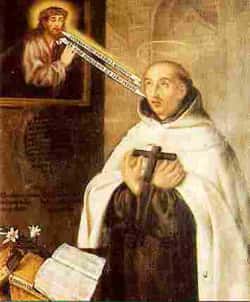 Saint John of the Cross was a sixteenth-century mystic who taught that the goal of the spiritual life is union with God, and that the soul must be emptied of self in order to be filled with God.
He describes how, in the ascent to perfection, the soul passes through the mystical experiences of the dark night of the soul and the dark night of the Spirit in his works The Ascent of Mount Carmel, and The Dark Night.
The Living Flame of Love
The Living Flame of Love, also by Saint John of the Cross, is a powerful poem spoken by a rare spirit inwardly transformed by the fire of divine love.
Though only four stanzas, this sublime and compelling message illumines our passage through the labyrinth of personal karma and prepares us for the Divine Encounter.
The Living Flame of Love
1. Oh, living flame of love
That tenderly woundest my soul in its deepest centre,
Since thou art no longer oppressive, perfect me now if it be thy will,
Break the web of this sweet encounter.2. Oh, sweet burn! Oh, delectable wound!
Oh, soft hand! Oh, delicate touch
That savours of eternal life and pays every debt!
In slaying, thou hast changed death into life.3. Oh, lamps of fire,
In whose splendours the deep caverns of sense
Which were dark and blind with strange brightness
Give heat and light together to their Beloved!4. How gently and lovingly thou awakenest in my bosom,
Where thou dwellest secretly and alone!
And in thy sweet breathing, full of blessing and glory,
How delicately thou inspirest my love!
The Summit Lighthouse®
Ascended Master Library
The Gold Mine Is Here
- Over 1300 lectures by Mark and Elizabeth Clare Prophet on angels, auras, healing and more
- Over 4100 dictations by the ascended masters on the spiritual path and how to attain your mastery
- Spiritual songs to the angels, ascended masters and hierarchs of the nature kingdom, violet flame, protection and healing decree services for your devotions, chakra alignment, karma balancing, aura cleansing and anchoring peace on the planet!
- Search by ascended master, date, category and more.
The Archives
For additional information please visit the Summit Lighthouse website. Learn how to become a Keeper of the Flame.