LECTURE: The Mahatma Letters by Mark L. Prophet, December 28, 1969
Lecture on The Mahatma Letters
by Mark L. Prophet, December 28, 1969
LECTURE TRANSCRIPT:
Class of the Golden Cycle
“The Mahatma Letters”
La Tourelle, Colorado Springs, Colorado
Messenger: Mark L. Prophet
I knew that if I gave her a spare moment that she’d turn it into a decree pattern. [laughter] But then we do get a tremendous amount of help out of the decrees.
I hope you’re enjoying the down pouring of snow. [clearing of throat, “yep”] I saw one head going this and some are going this way. [laughter, inaudible]
Student: It’s beautiful snow out here.
MLP: It’s beautiful. It’s nice and warm in here. [“uhuh”] And, uh, it’s a real pleasant winter season here in the Rockies. But I think most of you would be amazed to know that up until the class started we have had temperatures ranging from fifty to sixty degrees almost everyday and no snow on the ground, or no rain. And it’s been almost like parts of northern California. It’s been just wonderful here. And it’s true. But of course so many of the incoming people said that they wouldn’t feel quite happy in coming to Colorado without snow, [laughter] especially at this time of the year. [clearing of throat, “scuse me,” “ohh,” shuffling]
We have a very interesting subject today. It is the subject of the “Mahatma Letters.” What is a Mahatma? At the risk of your thinking I’m a bit funny, which you may think anyway, I want to say, in the Sanskrit, the word “maha” means great. And the word “atma” means soul. Therefore, a mahatma is a great souled one.
You may be interested to know that the atomizer is derived in part from the Sanskrit atma, at least I think it is. I feel it’s a derivative there, because it illustrates the breaking up of particles of one size into smaller particles. [bell’s sound] And we do this in an atomizer with air. We take perfume and we squeeze air in [sound of a baby] and it breaks up the perfume into droplets.
In one sense of the word one of the great Masters once said that man is actually a living soul, that God is a great soul, the great soul, the great ocean of soul, that the individual soul is one drop of water taken from the ocean. In this case the drop is unseparated, but always remains a part of the ocean. And in a real sense we’re talking about the ocean of consciousness. So the atma is the soul, the part, the part, the particle of God that’s broken up.
Well, how do you go about getting a mahatma. You go about getting mahatma because that mahatma that is just a particle of God’s soul begins to draw, as I explained yesterday in the Chart of the Presence lecture, begins to draw more and more of the divine radiance around himself and accumulates virtue on an individual basis, which is explained by Jesus’ statement, “Greater things shall ye do because I go unto my Father.”
You see there is a difference between the Godhead and the manifestation of God. The manifestation of God, by being given the gift of free will, is able to function with that free will and draw to himself virtue in excess of ordinary virtue that ordinary men would have. And this virtue can become greater and greater and greater. And it has nothing to do with ego because it’s a divine work. And so the soul can expand in its consciousness. And one soul can be greater than another [cough] or one star can differ from another star in glory.
And this explains why some Masters have a stronger radiation than others, or let’s qualify that, a stronger love radiation than another Master or a stronger wisdom radiation, or a stronger power radiation. Do you see? [clearing throat] This does not mean that the Master is deficient in grace.
Because in a real sense Adolf Hitler had a soul too. And we could suppose that his soul would be as good as anyone else’s soul. But his conduct was not. And we must, therefore, make a distinction between the deeds [clearing throat] and the doer. The doer, of course, is any of us. The deeds are what we do and we elect to do.
The mahatmas then have fallen under this category of “greater things shall ye do because I go unto my Father.” They have not only utilized to a larger degree the opportunities that life has presented to them, but they have also captured the momentum of the other Masters, and have utilized their momentum, of those who have gone before that is, to add to their own.
Now the interesting observation I would like to make here is that what man has done man can do. Anyone of us then can utilize the momentum of other Masters who have gone on before.
In fact, I would like to point out a very, a very important concept to you. [coughing] Each one of you in this room and each person on earth, if they fulfill their responsibility correctly, must enrichen the Godhead when they pass from the screen of life. Whether you ascend back to God or whether you pass through the change called death you should carry with you a momentum of service that will make the Godhead just a little bit more.
As Kahlil Kibran said of God, of the Holy Spirit, of life, he said it is a flame spirit gathering more of itself. [pause] And if you think about that you will realize that we are fulfilling a cosmic responsibility by becoming aware of the need to do greater things than we have done in the past. But let it not be a function of the ego. Let it not be done to exploit our fellow men [clearing throat], to enter into a spirit of vain competition between peoples. Let it be done solely and purely for the love of God and the love of men made in his image. If we do this then we can truly enrichen the Godhead because our offering becomes acceptable to God. An impure offering motivated by the desire to appear wise before men would in no way be acceptable to God. But if we serve with a humble and joyous heart we may be certain that the Father welcomes our service. For so do the angels in heaven function. [noise, clearing throat]
I have in my hand the book called The Mahatma Letters. This is a Theosophical Society book. And it deals with certain letters that were precipitated in the air by the Masters and were dropped out of the air and delivered to Madame Helena Petrovna Blavatsky.
The principles in the drama of The Mahatma Letters were the Ascended Master Morya El and the Ascended Master Kuthumi, known to others as Koot-Hoomi. Both of these men were fellows at Oxford at one time or another.
The “Illustrious” Master El Morya, of course, was Melchior, one of the three wise men that came out of the Chaldean hills at the birth of Jesus. Master El Morya was known in later times as Sir Thomas More, Chancellor of the Exchequer under King Henry VIII. He lost his head because he would not consent in good conscience to the marriage of Henry VIII to Anne [inaudible] Anne Boleyn, I believe, wasn’t that correct? [“Yes, uhuh, that’s right.”]
Some interesting observations on that one were the words of Sir Thomas More who without fear mounted the scaffold to lose his head and turning to the headsman said, “Do your job well. For you send me to God.” On another moment in the final moments of his life he said to the headsman, “Would you mind moving aside my beard because I do not think it has offended the king.” [laughter, “that’s very”] Before they led him up to the scaffold his wife and his daughters were weeping in the cell. And he grabbed a flask of his human urine held it up to the sunlight, sun came through and it was a golden amber color. He smiled at them and he said, “Me thinks this is the specimen of a healthy man who will live in the King wills it.” [laughter]
So we have here a man with great sense of humor, great courage [clearing throat] and a magnificent fortitude. The story of his life is well worth reading. He wrote Utopia. Later on after his ascension when he ascended as Prince Mori Wong of Kokonor [coughing] the beloved el, El Morya then [thumping] met with Madame Helena Blavatsky in her, in his tent in India‑-and I was trying to recreate in my mind and I’ll have it hear in a minute‑-Oh, yes.
It was in the time of Queen Victoria [clearing throat] that Prince Mori Wong rode in the Indian horse brigade before Victoria on a white charger. At that time Madame Helena Petrovna Blavatsky was Helena Hahn, she was a little girl of four and she went to see this and uh, she was watching the horses coming along and her little soul was thrilled.
Master Morya was astride this horse he saw her in the audience his eyes pierced her. [“uhum”] But she forgot the entire incident ’til she went to India and met with him in the tent, when he said, “Let me create a scene for you.” [clearing throat] He said, “There was a little girl of four in the crowd and the Indian horse brigade was riding. And there was one tall bearded Sikh riding a white charger in the front and his eyes suddenly swept the audience and met the four-year-old child. She says, “Who was that?” He said, “It was you.” She said, “It was you, Master Morya!” “Yes.”
And so gruff ol’ Master Morya, as he came to be known as, met with her there and recreated this scene, and showed her that the Masters have their eyes on people from the time they are children, and perhaps even not only in one embodiment, but through many embodiments and that there is a tie and that the skeins of destiny often link people together in a most remarkable way.
I have a particular reason, then, for bringing The Mahatma Letters to your attention today. And one of the reasons is because of some of the thoughts of the blessed Christian Scientists—and by the way, I’m not talking about the Christian Science Church, I’m talking about some of the false concepts that people have about negativity and positivity.
And this will apply also to some of the blessed Unity people. And we have many Unity people in our work. And they love it. And we love them and we love the Scientists. My own wife was a Scientist.
But it is important that I warn you, then, about one of the most clever strategies of darkness, which will come forth in fuller detail by far in my forthcoming book, after we finish this one we’re going to start on the second book, which is called “Strategies of Darkness.”
So I want to illustrate to you the fact that one of the most effective tools the dark forces have in dividing people is on points of doctrine.
There are many people, then, who are convinced that no one should ever think, feel, say, or do an evil thing. And I quite agree with the idea. From a practical standpoint, however, people still make mistakes. Now, I want to point that out. And we are concerned with the cause an’ effect relationship.
I have pointed this out in the past by saying, “That a man is driving a car down a road. And as he drives it down th’ road ahead of him about a hundred yards away there is a large grey rock that has tumbled down the mountainside.” You’ve seen these signs, you know, where it says. “Warning. Watch out for slide. Slide area. Be careful.”
“Now this man is a positive thinker. He doesn’t believe a rock can come tumble down in his path. So as he sees this rock ahead on the road he says, ‘No,’ he says, ‘it isn’t there.’ [laughter] So in the old words, you know, of, of that [coughing], uh, automobile club, the american automobile society, AAA, ‘He was right, dead right as he sped along. But he’s just as dead as if he’d been wrong.” So the people just go right on toward this rock because you see it isn’t there, ’til they crash right into it.
We have to be positive thinkers. And the poor little negative rock doesn’t exist. [cough] My contention is and the Masters agree with this and I really learned it from them, that when that rock is there that rock of negativity our roll is to see it, recognize that it is not truth, that it is not God, [whispering] that it is not the kingdom of heaven, that it shouldn’t be there but it is, and therefore steer around it, [laughter, “right” “yeah” inaudible] avoid it.
Now, if you’re going to be so completely and absolutely positive as a positive thinker that you say that if you have a sore throat, “I don’t have a sore throat, it doesn’t exist. And, therefore, I refuse to take any precautions about it whatsoever,” it can get worse, right? And as Estella Lenci told me recently about the Negro practitioner in Christian Science that was so effective. This woman, of course, used the power of positive thinking by saying wherorit people called her up for a treatment the only thing she said was, “It ain’t!” [laughter] And she healed people of everything from cancer to TB to heart trouble and everything just by saying, “It ain’t.” So there’s a great deal of power and much to be said in favor of positive talking and positive thinking.
But our contention in the Summit Lighthouse is that there is a time and a place for all things. The Bible says there is a time to be born. There is a time to die. There is a time to plant. There’s a time to harvest. You see. And there is a time to use nothing but positive thinking. But there is a time when you should have awareness of what is going on in the negative world only with the view to counteracting that which is going on and bringing forth the great power of the positive thought that you wish to introduce.
The Mahatma, then, were very wise men. But they were living and working with Madame Blavatsky at a time in our history when, of course, Madame Blavatsky and Annie Bessant and many of the early fe, Colonel Olcott and some of the Theosophical Society figures were trying to break through the stone wall that surrounded people in the transition from orthodoxy, absolute orthodoxy of the Middle Ages almost, of the dark ages I should say, to try to bring forth a glimmer of light that was the introduction of the Masters of the Far East to America and England and to the world and to India.
Naturally they had a lot of problems. [clearing throat]
Now, the reason I wanted to lecture on The Mahatma Letters, then, is because today in the latter times the battle of Armageddon is not only looming, it is with us. And at this time of the battle of Armageddon it is absolutely necessary that the students sometimes see these rocks in the middle of the road and when they see them know that the Masters did not put them there. That they should also understand that it is not necessarily true that their karma put the rock there.
We’re living in a big world. And in this world where time and space play such an important part we are dealing with interlocking karma, which means that if you are a saintly person and your karma is absolutely that you should be delivered from all evil, and you are living in a community that is near a volcano or you have built your house on a riverbank near a levy, if something happens that causes an overflow of this water, there is a rise in the water, or there is a disturbing condition that causes a volcano erupt, your proximity to danger regardless of your karma can produce some harm even though you may have no particular specific karma that would actually deserve your destruction. But you may have your home destroyed or your automobile or you could even have a member of your family injured simply because you are living on the banks of the river. You have chosen to live there. And there is a responsibility that is given to all us to take reasonable and prudent care concerning our karmic situations. And we ought not to lambaste the deity because we sometimes have problems when common sense would already have shown to us that there would be a very definite possibility of danger in whatever undertaking we might be involved in.
It has been said, Thou shalt not tempt the Lord thy God. And as I remember the scriptures when the serpent came to Jesus and said, “Why don’t you cast yourself down from this mountain if you’re the Son of God, for after all it’s written he will give his angels charge over thee lest thou dash thy foot against a stone.” It is the most beautiful idea. Because it clearly illustrates what I’m trying to tell you.
Jesus did not accept the temptation of the dark forces. He recognized the responsibility he had for governing his life. And he knew that although it was true that if he were cast down from the mountain that the angels would have charge over him, he also knew that this could come about if through no fault of his own, when he had taken all reasonable precaution, he accidentally tumbled down the mountain he probably would land in a bush or something or a haystack or something would come up that would save ‘im.
But he did not tempt God and we also ourselves should not. Therefore, because we are living today in a very dangerous time, and because at the time the Theosophical Society brought forth their teachings they were living in a dangerous time, when humanity was inclined to lampoon them, to poke fun at their teachings, in general to destroy if they could the Master’s teachings, there naturally was introduced a great deal of dissension into the society, and you cannot expect today that an organization that is avant garde like the Summit Lighthouse is going to fail to have attacks by people who are ignorant of what the truth is.
People from time to time will decide on the basis of their emotions that a person is either good or bad, that an activity is either good or bad. Very few people are able to see what I will call the grey tones in life. [pages turning] We deal almost entirely in blacks and whites. We have a need, a compulsion almost, a mania, to render judgment on almost everything, whether or not we know something about it. And a little knowledge becomes of all things the most dangerous. Because the little knowledge enables us to say, “Well, I have been there, and I have heard this man, or I have heard this woman speak and I either like it or I don’t.”
Now, you should realize as I have learned to realize that many people whom I have heard speak on one particular occasion [cough] did not impress me particularly or maybe they impressed me tremendously, either way. And maybe the next time I heard them they either impressed me uh, very badly, where at first they impressed me very favorably, or that first time I heard them I was unimpressed and the second time I was shocked and I realized the virtue and value of what they had to present. Now, this is not something I’m talking about for us. I’m talking about any speaker anywhere. [cough] You see. [pause, clearing throat]
So, then, we should understand that there was a reason why the “Mahatma Letters” were written. We should also understand that we are living in a time of conflict where from time to time the Masters have to clarify certain points in order to bring mankind out of the pitfalls and dangers that otherwise would befall ‘dem. I would like to draw a few pertinent examples.
Several years ago when the Summit Lighthouse first started, what many of you did not know, is that I was the Messenger then of the Summit Lighthouse, that Madame Helena Petrovna Blavatsky [clearing throat] embodied at that time in a body of a woman in Philadelphia, who, by the way, if you saw her picture looks exactly like Madame Blavatsky and she was Blavatsky, she was the first editor that the Summit Lighthouse ever had. She was employed by eli, not, Elizabeth wasn’t with me. But she was employed by me and by the Board of Directors to edit the material, that is, put the punctuation in. I would take the dictation and put it on the tape and she would put the punctuation in and then we would print it.
And she had an agreement with me and I had an agreement with her that we would agree to accept her editing and she would agree to accept our dictations from the Masters. Well, this woman within a very short time decided that she didn’t like everything that I was giving her.
For example, one night in Washington D.C. at sunset [thump] I was kneeling in my sanctuary facing the setting sun when suddenly the window was obscured and there was no window there. In it’s place there was nothing but blazing light. And in the middle of that light stood the Archangel Gabriel. And I was almost like the keepers at the gate of the tomb of Jesus, I almost fell flat on my face. This was not an arc light, it was not the sun, it was no ordinary phenomena although it came at sunset when the sun was coming. It was not hallu, an hallucination. It was a definite factor because my whole body was absolutely charged with light. And it almost raised me off the floor. I was just like a balloon, I was so light.
And then Gabriel began to speak out of this Light. And I got a pencil and I wrote a few things that he said down. And they were all simple, like a child would speak. He just said, “I am Gabriel.”
Unfortunately, people when they read words many times do not realize the power of which they are spoken. So when my little message for a Pearl of Wisdom arrived in Philadelphia for editing it appeared to be very simple.
She called me up and said she couldn’t use it. And I said, “Why not?” She said it’s too childlike, too simple, too ordinary, too repetitive, too everything, too negative. I said, “Don’t you feel the radiation of the Archangel in it?”
And she screamed back over the telephone to me and she said, “My God,” she says, “it’s filled with radiation! But I can’t print [thump] radiation!” [laughter] She says, “I can’t print radiation. I’ve got to give the people words.”
So, she said, “I’m going to make up my own dictation and I’ll print it and that’ll be a Pearl.”
Well, I argued with her to no avail. And so we had to print it by agreement. And the real dictation never got printed that week.
And as the months passed by, she took increasing liberty with the dictations. This was in the year 1959. And when November rolled around, Master Morya wrote a beautiful letter, one of the most magnificent letters you’ve ever read in your life in which he fired her. [laughter]
And in that letter he said, after handing her a lot of complements, he said, “This woman like Vesuvius has continued to erupt through the years.” [laughter, “Gees.”] She read that letter to her students assembled in Philadelphia, bless her heart. And they were a little stirred. And she said, “Can you imagine an ascended being making a statement like that about me?!”
The reason I’m telling you this is because many people imagine the Masters to be sweet, sophisticated little Jesus, with long curly hair, marcelled and parted in the middle, and with a sweet angelic face, perhaps with blue eyes, and almost Maybeline(?) on the eyelashes, you know, curled up. [laughter] You think I’m kidding? People think that Jesus is like that.
Jesus, he sweat, and his robes got dirty, and he got tired when he went a long way on foot. And he curled up in the head of the boat and went to sleep because he was tired and tired of the vibrations of people who wearied him. And he felt the need to withdraw from the tiring, wearying world and commune with God. I want to point that out to you because Jesus was a strong, powerful man. He could run the gamut of human emotions. He could be so soft, so sweet. He could say, “Consider the lilies of the field how they toil not neither do they spin. Yet I say to you that Solomon in all his glory was not arrayed like one of these.” Or he could suddenly turn and say, “You generation of vipers, you are of your father the devil. He was a murderer from the beginning.”
Now, why am I doing this? To show you [coughing, whispering] that there are two sides to the Ascended Masters because the Masters are dealing with that d-blank rock. [laughter] It’s in the middle of the road. It’s true. The rock is there.
And you know what the rock is? It’s human stubbornness. It’s human pride. It’s human insolence. It’s human imagination. It’s human stupidity and ignorance. It’s human sophistication and wisdom, the wisdom of this world that is foolishness with God. It’s all of these things and many more. And as a result of this human activity, churches have been torn in half and divided.
Martin Luther tacked his manifesto on the door of the Catholic Church, and of course justifiably, against the indulgences and the immorality and all the thing took place.
But again and again the fragments of the Christianity that Jesus taught had been broken and broken and pummeled and broken apart until what we see in the present day is nothing more than a machinistic presentation of orthodox concepts so removed from the reality of Jesus Christ and the power that God originally put in the de’man that we cannot even today hold together the remnants of civilization with it. Do you see?
You can hold society together. And the young people today don’t even believe it. Because they see through the awful charades in which civilization has been engaged, including men of the cloth. And the same thing took place in the time of the founding of the Theosophical Society. Therefore, mor, Master Morya has to get out his own letter in which he had to reveal what this woman had done and fire her.
Let’s consider the alternatives. If the Master had said nothing, the woman, herself, said plenty. She was on the platform giving an, a running account of my life as she knew it, in Philadelphia. She serialized it, like the “Secret Storm” [laughter] or “Dark Shadows.” [laughter]
And Mary Spelzhaus, I don’t know if she’s here or not, is she around?
Mary Spelzhaus: Yes.
Mark L. Prophet: Mary, you were present when she was serializing my life story, do you remember it?
MS: Yes. [“uhum”]
MLP: And this is what happened. In Philadelphia there she was bringing forth point by point my life story and the whole purpose of that was that she was going to dump me, [laughter] and have her own activity.
Well, Master Morya said to me, “I knew what was coming when you first got together.” And he said, “I felt that I would make it like a Hershey bar, so that I could easily break it in two without too much ado”‑-which he did.
I want you to know this because I want to show you that one of the greatest strategies of the powers of darkness is to impugn the nature of God-loving people who happen to defend their own position when they are under the most scurrilous attack without any fault of their own. The rock has come down the mountain. It lands on the path of [cough] life and that rock is there. And they are telling people, “There the rock is and I’m going to go around that rock.” And the people say, “You shhhhhhhhh, you shouldn’t say that. That’s negative. Don’t say things like that. Always speak positively, speak well of everybody.”
Did Jesus speak well of everybody? Let me tell you something. There is no more despicable thing in this universe than condemnation, criticism, judgment and gossip. This I assure is true. But at the same time Jesus said, “By their fruits you shall know them and the truth shall make you free.” Therefore, the truth is not gossip. It all depends on the motive. The motive is behind it.
When you tell something, someone comes to you and they say, “What do you think of this?” if you tell them something against a person [cough] because you want to destroy that person, you hate them, you’re jealous of them, that is a sinful activity of gossip, criticism, condemnation and judgment. But if out of the love of your heart you speak honestly and sincerely and you say, “Well, he, here’s the facts. But let’s not worry too much about it because God will take care of them.” If you answer honestly, that is not gossip unless you make it gossip.
And, therefore, I present some of the “Mahatma Letters” to you because I want you to see what the Masters said. And I assure you that when you hear these you will know that it is the Masters talking. But I want you to know also that the Masters don’t always talk like that song goes, “Sweet Little Jesus,” or “Jesu Joy of Man’s Desiring,” all these things. Sometimes they are hard-boiled and tough because we are so waterlogged with emotion in our world as human beings. We are so hidebound by convention. We are so determined that we are right in our smug little attitudes of self-conceit that many times it takes dynamite to dislodge us. You see that. It takes a lot of energy and a lot of power in order to finally wake us up and realize what the truth is.
I learned last night of a man who claims to be a man of God, who claims to be a real wonderful master, a living master in the flesh, who was engaged in an immoral act with a woman in a certain part of this country, an absolutely filthy immoral act. Yet that same man came out and from the platform all over America he blasted and lambasted American people and American women. And he said of these American people, these American women, he said, “Why don’t you follow Christ?” Yet he himself was and is an immoral, filthy minded person who stands up on the platform and dares to come out and condemn others. Now do you understand me? [“Yes.”]
Well, do you think that life will forever let him hide behind the veil [“No”] of his popery? [inaudible] It’s not the pope. No, I wasn’t talking about the pope, [laughter] but I mean the popery of his own self-righteousness. I tell you no. For it shall be shouted from the housetops what he has done in secret. But I do not wish to be a party of it. I wish to have no part in it whatsoever.
So I want to read you some of the “Mahatma Letters.”
Here’s Letter number thirty.
[Messenger reads from The Mahatma Letters, pp. 228-230, 240.]
Here’s,
LETTER No. XXX
Private. [laughter]
My dear Brother.
Perhaps, a week ago, I would have hardly failed to embrace this available opportunity and say that your letter concerning Mr. Fern is as complete a misrepresentation of the spirit, and above all, of the attitude of M[orya] towards the said young gentlemen, as your complete ignorance of the aim he is pursuing could produce—and I would have said no more. But now, things have changed; and though you have “come to know” that we “did not really possess the power of reading minds” as had been pretended, nevertheless, we know enough of the spirit in which my last letters were received, and the dissatisfaction produced,‑-to suspect, if not to know that unwelcome as truth may often come, yet the time has arrived for me to speak frankly and openly with you. Lying is a refuge to the weak, and we are sufficiently strong, even with all the shortcomings you are pleased to discover in us, to dread truth very little; nor are we likely to lie, only because it is to our interest to appear wise concerning matters of which we are ignorant. Thus, perchance it might have been more prudent to remark that you knew that we did not really possess the power of reading minds, unless we brought ourselves [through] thoroughly en rapport with, and concentrated [a] an undivided attention on, the person whose thoughts we wanted to know‑-since that would be an undeniable fact, instead of a gratuitous assumption as it now stands in your letter. However it may be, I now find but two ways before us, with not the smallest path for compromise.
[Now, I’m going to cut some part of this out.]
My dearest Brother, are egregiously mistaken from first to last! Your whole letter is based upon misconception, an entire ignorance of “missing links,” which alone may have given you a true key to the whole situation. What can you mean by the following?
My dear Master.
Amongst you you are utterly spoiling Fern‑-it is a thousand and pities‑-for he is really a good fellow at heart and he has an intense desire for occult knowledge‑-and strong will and a great capacity for self-mortification‑-he would I am sure be useful for your purposes; but his self-conceit is growing intolerable and he is becoming a confirmed fabricator of fiction and this is due to you all. He has thoroughly humbugged Morya!! from the first‑-and he has gone persistently lying to Sinnett to keep up the delusion he has got Morya to entrust him with secrets and to accept him as a chela and he now thinks himself a match for anyone. . . . Morya replies quite falling into the trap . . . this fraud no doubt commenced in [y]our interest . . . …and so forth and so forth and so forth.
It is unnecessary for me to repeat once more what I have said before; namely, that up to receiving your first letter concerning Mr. Fern, I had never given him one moment’s attention. Who then, amongst us‑-spoils that young gentleman? Is it Morya? Well, it is easy to see, that you know still less of him, than he knows, in your conceptions, of what you have in your mind. “He has thoroughly humbugged Morya.” Has he? I am sorry to be obliged to confess that, in accordance with your Western code it would look rather the reverse; that it was my beloved Brother who “humbugged” Mr. Fern‑-had not the ill-sounding term another meaning with us, as also another name. The latter of course, may appear to you still more “revolting,” since even Mr. Sinnett, who is but the echo in that of every English Society man, regards it as thoroughly revolting to the feelings of the average Englishman. That other name is‑-PROBATION; something every chela who does not want to remain simply ornamental, has nolens volens to undergo for a more or less prolonged period; something that‑-for this very reason that…is undoubtedly based upon what you Westerners would ever view as a system of humbug or deception‑-that I, who knew European ideas better than Morya, have always refused to accept or even to regard any of you two as‑-chelas. Thus, what you have now mistaken for “humbug” as coming from Mr. Fern, you would have charged M[orya]. with it, had you only known a little more than you do of our policy; whereas the truth is, that one is utterly irresponsible for much he is now doing, and that the other is carrying out that of which he has honestly warned Mr. Fern beforehand; that, which,‑-if you have read, as you say, the correspondence‑-you must have learned from H.P.B’s letter to Fern from Madras, that in her jealousy for M[orya].’s favours, she wrote to him to, to Simla, hoping she would thereby frighten him off.
Does that sound particularly spiritual? But it is a letter. And you know who wrote it? [cough, papers or pages shuffling]
Student: Kuthumi.
MLP: Huh?
Student: Kuthumi.
MLP: Right. [laughter] [papers shuffling] He ended the letter saying.
…Meanwhile, I must close, reiterating to you once more the assurance of my sincere regards and esteem.
Yours
- H.
Believe me you are too severe upon and‑-unjust to Fern.
Now, [pause, pages turning] I’m going to read another one of Kuthumi’s letters.
“Received London, March 26th, 1881.” This is from Kuthumi also.
It is from the depths of an unknown valley, amid the steep crags and glaciers of Terich-Mir‑-a vale never trodden by European foot [but] since it’s the day its parent mount was itself breathed out from within our Mother Earth’s bosom‑-that your friend [send] you these lines. For, it is there K.H. received your “Affectionate homages,” and there he intends passing his “summer vacations.” A letter “from the abodes of eternal snow and purity” sent to and received‑-“At the abodes of vice” ! . . . Queer, n’est-ce pas? Would, or rather could I be with you at those “abodes”? No; but I was at several different times, elsewhere, though neither in “astral” nor in any other tangible form, but simply in thought. Does [that] satisfy you? Well, well, you know the limitations I am subjected to in your case, and you must have patience.
Now, remember, folks, that these letters were precipitated in the air in red and blue pencil. And they were dropped right out of the air and were seen by many people. In fact, they’re still in the museum in London, these Mahatma Letters.
I guess this one‑-Yes. Here is way, one, some of them look. This is one from Morya. Can you see that? [“Yes.” “How big he writes.”] Yeah, he wrote rather big.
And here’s Koot-Hoomi, part of it is it, sometimes it came in Sanskrit and sometimes in English [“Yes”], those insignatures Koot-Hoomi Lal Singh. [noises]
So he goes and he says,
I do not complain; but the [vare] fact of your addressing me as “Master” in your letters‑-makes me the laughingstock of all our Tchut, Tchutuktus [Wow. (laughter)] who know anything of our mutual relations. I would never have mentioned this fact, but that I am in a position to demonstrate to you by enclosing here a letter from Subba Row to myself‑-full of excuses, and another to H.P.B.‑-as full of sincere truths,‑-since they are both [che] chelas, or rather disciples. I hope I am not committing an indiscretion‑-in the Western sense. You will please return to me both after reading them and noting what they say. This is sent to you in strict confidence and only for your personal instruction. [You’ll receive therein] You’ll perceive therein, how much [your] you English have to undo in India, before you can hope to do anything good in the country. Meanwhile, I must close, reiterating to you once more the assurance of my sincere regards and esteem.
Yours
- H.
Believe me you are too severe upon and‑-unjust to Fern.
Oh, I’m sorry. You know what I did? [inaudible] I, I’m very sorry I, I got the wrong part there. No. It was easy to do because I got carried away with showing you those illustrations. I’m sorry about it. I’ll continue there where I was.
Your future book is a little jewel; and, small and tiny as it is, it may, one day, be found to soar as high as Mount Everest over your Simla hills. Among all other works of that class, in the wild jungle of Spiritualistic literature, [Take notice of that, “in the wild jungle of Spiritualistic literature”]—it shall undoubtedly prove the Redeemer, offered as a sacrifice for the sin of the world of Spiritualists. They will begin by rejecting‑-nay‑-vilifying it; but, it will find its faithful twelve and‑-the seed thrown by your hand into the soil of speculation will not grow up as a weed. So far may be promised. You are oft too cautious. You remind too often the reader of your ignorance; and presenting but as a modest theory, that, which at the bottom of your heart you know and feel to be an axiom, a primary truth‑-instead of helping, you but perplex him and‑-create doubt. But it is a spirited and dis-criminative little memoir, and, as a critical estimate of the phenomena witnessed by you personally far more useful than Mr. Wallace’s work. It is at this sort of thing that Spiritualist ought to be compelled to slake their thirst for phenomena and mystic knowledge instead of being left to swallow the idiotic gush they find in the Banners of Light and others. The world‑-meaning [thet] that of individual existences‑-is full of these latent meanings and deep purposes which underlie all the phenomena of the Universe, and Occult Science…, reason elevated to super-sensuous Wisdom‑-can alone furnish the key wherewith to unlock them to the intellect. Believe me, there comes a moment in the life of an adept, when the hardships he has passed through are a thousandfold rewarded. In order to acquire further knowledge, he has no more to go through a minute and slow process of investigation and comparison of various objects, but is accorded an instantaneous, implicit insight into the…very first truth. Having passed that stage of philosophy which maintains that all fundamental truths have sprung from a blind impulse‑-it is the philosophy of your Sensationalists or Positivists; and left far behind him that other class of thinkers‑-the Intellectualists or Skeptics—who hold that these fundamental truths…are derived from the intellect alone, and that we, ourselves, are their only originating causes; the adept sees and feels and lives in the very source of all fundamental truths‑-the Universal Spiritual Essence of Nature, SHIVA the Creator, the Destroyer, and the Regenerator. As Spiritualists of today have degraded “Spirit,” so have the Hindus degraded Nature by their anthropomorphistic conceptions of it. Nature alone can incarnate the Spirit of limitless contemplation. “Absorbed in the absolute self-unconsciousness of physical Self, plunged in the depths of true Being, which is no being but eternal, universal Life,” his whole form as immovable and white as the eternal summits of snow in Kailasa where he sits, above [kae] care, above sorrow, above sin and worldliness, a mendicant, a sage, a healer, the King of Kings, the Yogi of Yogis,” such is the ideal Shiva of Yoga Shastras the culmination of Spiritual Wisdom. . . . Oh, ye Max Mullers and Monier Williamses, what have ye done with our Philosophy!
[“huhm”] Do you see how absolutely interesting the Master was in presenting these various things, which in a way would appear to be almost a condemnation or indictment of certain people and places?
Now, in our activity, we have found in the Summit Lighthouse very little desire to do this sort of thing. Of necessity on rare occasions the Masters have had to bring forth some element and personalize it. In most cases the Masters do not personalize this type of knowledge. Do you understand? [“uhum”] In most cases the Masters will give examples that are separated from the personality. But sometimes it is almost impossible to do that. You understand this. It’s almost impossible to avoid it. I’ll tell you why.
One time I had a staff meeting here where I had a chela in here, one of our chelas who is now on the staff, who had a very grievous fault that had finally reached a point where it was out of all proportions and we had to do something about it. We had spoken privately to the chela and the chela did nothing to correct it. So we decided that we would go ahead and issue it forth in a nameless diatribe almost [laughter] from the pulpit and in no way would identify who we were talking about.
And we, we pointed out this fault. And we went on with it, and gave a lecture about half hour. When lo and behold what should happen? But almost half of the chelas in the place decided that they were the one named. [laughter]
In fact, they were certain, that it, that we were talking directly to them. [laughter, murmurings, cough] So this is a very interesting thing too. So sometimes you almost have to get right to the person in order to correct the condition. [noises, cough, papers shuffling]
Now, if you’ll bear with me and I’m going to find a certain thing here that I think’s very interesting.
By the way these, this, this book, The Mahatma Letters‑-[thump, “whoew” “oooh”] Think nothing of it. Things sometimes jump around here, you know. [laughter] But The Mahatma Letters are quite tremendous and they contain a, a wealth of wisdom.
Now, Dr. Otto Isaac is here. At Elizabeth’s request he has been reading The Mahatma Letters. I want to ask Dr. Isaac if what I say is not, in your own opinion, true?
Dr. Isaac: Yes, very definitely. There is a lot of material in there that, that would be worth anybody’s time to go through.
MLP: Tremendous. And we will try to order these books if anybody ever wants them, yu. We’ll try to get them fer anyone that would want a copy. But they are tremendous although they date way back into the 1800s they give great insight to people. [pages turning, clearing throat]
Student: Are those books more or less‑-they point out the faults of the date, [unintelligible] of the day, the wrong [unintelligible].
MLP: I would say that they’re very apropos of today as well as then.
Student: That’s what I mean. [inaudible]
MLP: Yeah.
Student: That’s what I thought.
MLP: They’re very good. And I, I presented this lecture and I’m presenting this lecture particular to point out that the motive changes everything. The Masters were not trying to tear the chelas apart. They weren’t trying to tear apart Mr. Sinnett or tear apart Colonel Olcott or Madame Blavatsky or anyone. They were simply trying to bring forth the truth. And, of course, the dark forces always make capital of this.
For example, one time, in one of our conferences here, several months ago, several years ago, we had a gentlemen here who was quite a financial wizard, who attends all the financial conferences of the world. He belongs to some of the secret societies that have to do with finance. And he considers himself quite a sage, very, very wise. And so he came to our meeting here and he was sitting in the back row and I happened to give a lecture in which I mentioned this thing that I brought out this morning about Jesus and Sananda.
Well, this man has been consulting a medium, a spiritualistic medium for many years up near Mount Shasta, California. And he goes to her regularly for readings. And so somewhere along the line the false hierarchy had gotten through to him and presented to him the name of Sananda.
So when I spoke as I did from an honest heart and told the truth about the whole situation, that was all that happened at the meeting. He left here and he never heard another word before that thing that I said nor did he hear another word after it. The only thing he heard, the only thing the mee, the meeting had, had come to mean to him was the fact that I had dared, in his opinion to criticize persons unnamed and unknown, when I was not at all criticizing anyone but dealing with an impersonal principle which the Master himself had told me I must bring forth so that the people would have the knowledge. Whether they accepted it or not was up to them. I could not give them a lie. Because if I gave them a lie, you see, then I would be guilty of bringing forth the lie and the guil, and the lie would enslave them. But if I brought forth the truth, whether they all accepted it or not at least I’d given all the opportunity of doing it.
But this man couldn’t think of anything else‑-all the beautiful dictations, all the magnificent lectures he heard, and he heard many of them, and other people said so, fact most everyone said so, he couldn’t hear anything else accept that I had said that one thing. And that became an anathema to him.
And he wrote and he said he would never want to come to another conference because he couldn’t enjoy my tearing apart people and he believed that Jesus was Sananda and he was not Jesus; he was Sananda.
Well, I don’t think I even answered him, but if I did answer him I would have said something like this‑-“My dear Sir: Whatever you wish to believe is your privilege. And whether or not you wish to attend here or not is also yours to determine. My role is to bring forth the truth as I see the truth, as God has revealed it. And whether or not you realize it, I have spoken honestly and I will continue to speak honestly. Those who love the truth will be here. And yet every man must decide for himself.”
But, of course, one thing I myself have found out—and I have been in the past a rejecter of truth as well as a rece, as uh, uh, perceptor and one who would acknowledge truth. I have done both. I have looked at truth and taken it into my heart; I have looked at truth and not recognized it and have shut it out, but I have always kept a receptive mind, and many times I have gone back—
For example, many years ago when I was working on the railroad track laying steel, on the Soo Line Railroad‑-one hot afternoon when th, this was my first contact with the Ascended Masters that I had ever had in this life, and there I was my face smarting and burning with pitch and tar, my hands all covered with tar and sweating, smarting and stinging, I was tired, the sun was beating down almost a hundred degrees, a very good time for for a hallucination to occur, men were all around me, and I had a pick in my hand and I raised the pick up over my head, like this.
Now, if you were working on the section and you saw a man raise a pick up like that and he stood there for five minutes with a pick up‑-you’d decide he was either crazy or into some kind of cataleptic fit wouldn’t you? Well, that’s what happened to me.
For five minutes I had a conversation with a Master in Tibet. But here’s the funny thing about it. That pick was only up a fraction of a second and it came down and I continued to work. But the Masters extended that one or two seconds while it was up into five solid minutes of time.
And during that time I heard a conversation from the Master concerning myself and my destiny, identifying himself. But I was a very good Christian. I prayed everyday three hours a day. I read my Bible by the hour. And I believed only in the orthodox theology that is taught by all the people like Oral Roberts and Billy Graham and, and the late—oh, what’s his name? this great theologian that lived in Chicago, and—well, Harry Emerson ________, for example, and this type of people, I believed just as exactly as everything is written an accepted by the average, good Christian.
And so when this voice came to me from out of the void and told me who he was, lived in Tibet, I was quite astounded. And I thought that I was hallucinating and would no doubt have continued to think that I was hallucinating if the Master had not forwarded to me by Western Union telegram the following Sunday morning the confirmation of the facts which he had given me that day in this dissertation while my pick was up. Do you understand?
But such was the case and it was no ordinary situation. A real Western Union boy, a real live Western Union boy with a bicycle, [laughter] with a piece of yellow paper in his hand, drove up to the door with a thundering [thump] rap, [thump] got me out of bed on Sunday morning. And it was a tangible message I could hold in my hand. It was not a hallucination.
A few months later out of the fear of hell fire and brimstone and the possibility that I might in some way be doing something I shouldn’t, I told the Master that I didn’t know whether he was of God or not and I was afraid of him and he should get out of my world and stay out, [laughter] so strong was the hold of orthodoxy on me. And he bowed to me with the sweetest bow you ever saw, and he said, “My son, as you have spoken so shall it be.” [fingers snapping] And he was gone.
And he never returned until in the state of Colorado here many years later I invoked him and begged him to return. And he didn’t come when I called him. [laughter] And I kept on calling. And he finally came. And thus began a new romance.
But I have been a rejecter of things because I have been a man of good conscience and I have tried to exercise it properly. However, after all prayers and praisings and living to the best of my ability and calling to God to show me the truth, he brought me into this light and has continued through the years to reveal more and more of his light.
And the Summit Lighthouse is today considered by the Masters to be the greatest forum on this planet, not necessarily of great intellectual tones, although we are going to have that too, we will have something for everyone, but an organization that will teach deliverance to the human spirit from the superstition that has bound mankind through the ages to a point where science is estranged from theology and theology is estranged from science. We, therefore, propose and we believe, in addition to proposing, that these proposals have been made by the Masters before, to unite all the varying departments of life under one magnificent banner.
We do not see that even the preparation of food or ordinary dress is without some divine grace. We believe that we have and hold a responsibility for our lives to try to make them interesting under divine grace, do you see—interesting for ourselves, for our children, for those that are around us.
We realize in the simple analogy of the dazzling sun‑-that if you and I were to face the dazzling sun of the pure Absolute and the dazzling sun of the Absolute were to strike and impinge upon the retina of our eye, that we would be unable to see anything, so bright would the light be. There would be no form, no substance, no awareness of time or passage thereof, no awareness of space, only the dazzling light of the Absolute. And in one sense of the word it would seem to efface from us all reality and yet it would be all reality. [cough]
Therefore, we consider that reality is a most important thing. And we consider that all of the experiences of life here are destined to bring us to the understanding the law wants us to have, so that if we return to the great light and are able to face the Absolute and to blend with the Absolute it will be with an awareness of the potential of the Absolute to create public expression in every way and every sphere and therefore create beauty outside of the definition or lack of definition of the Absolute, which is so white, so dazzling, so pure that it has no particular color or demarcation within it. Do you see?
We assume, then, the pure white light is broken up into the colors in order to create beauty and variety, variegation, wonder in our own eyes. And we are not all carbon copies of one another outwardly. Inwardly I suppose that a man who would accept the fullness of God would have to look like another man who accepted the fullness of God. But the, the free expression of individuality comes abart, about through the use of the power of the I AM Presence in the field of personality where the prism of the Holy Spirit functioning through the Holy Christ Self causes a varying pattern of reality to shine forth for each lifestream. Each person, then, can be different while receiving or deriving its power from the same great Source, the I AM Presence.
Do you understand, then, that in this vale of tears, down here on earth, in the struggles to reach the true nature of our being it is necessary that we have various experiences. If all these experiences were completely positive, completely, absolutely beautiful, there would be no soul growth. For a great deal of the soul growth comes about through resistance and through the power of change within ourselves where we recognize the need to change. And we reach up to God and we say, “I don’t like this intolerable condition. Father help me overcome it.” And that’s wonderful.
And the [thump] Masters [thump] in these [thump] letters here show how the struggle in the spirit between the forces, the reactionary forces of a contemporary theology in any age are locked in an almost life-and-death struggle with the great cosmic truths of the ages.
You are always, then, when you deal with an organization like ours going to find conflict. Do not expect that it will free you from conflict in yourself. If anything it will highlight conflict.
But it’s like Dr. Isaac said to me today, he said, “I sometimes have to hurt people a little bit in my adjustments.” [laughter] And he said, “Sometimes when I make these adjustments they’re sorer after they’ve had them than they were before,” but he said, “if they wait a little while they’ll find out that it will come to great healing and a healing process.” And this is a very important point for people to realize.
It is necessary for people sometimes to walk a little bit of the road to, uh, the wia dolorosa, and to have a little crucifixion in order to have a better resurrection. And we never in God’s world are going to overcome if we fail to face it. And I think the best examp‑-face life. The best example of that is in the chela who came one time to our Heart Center and said, “There’s too much conflict in the Heart Center. I mean, I was happier before I came. I want to go up in the mountaintop and get away from people because I simply can’t stand to be around people, even spiritual people, they make me sick.” [laughter]
So I said, “Well, alright you go right ahead an’ you go up in the mountaintops.” So they went up in the mountaintop and they come back and they said, “Well, I know I’m right because now I have perfect peace.”
And I went to the Master and I said, “Master, eh, they’ve shook me up a little bit with this statement. Should I go to the mountaintop too?”
And he says, “What mountaintop?” [laughter] “What mountaintop?” [inaudible] He said, “These people,” he said, “will have to go ahead and retrace every single ounce of their footsteps.” Ah, not ounce, I mean, every single mile of their footsteps, they’re gonna have to go back over the same ground. You can see that.
He says, “They’re not learning how to get along with people. They’re learning how to get along with themselves. And all they’re really doing is they’re actually stifling their own conflicting thoughts and making or compelling themselves to think things that they feel are harmonious because they want peace and safety more than anything else and they have it, but they’re literally dead,” the Master said. “They’re dead in trespasses and sins of self-consciousness, self-awareness, but without a self-awareness it reaches out to know what’s going on in the universe.” He said, “People have to learn to get along with each other.” He said, “They’re never going to be able to enter into heaven through separation. They only enter into heaven through harmonization and communion with others so that understanding and the fruit of understanding is born inside of them. And then after awhile they learn how to govern the conditions.”
Will you wake that lady up, I know I’m very boring, but‑-[“Oh, excuse me.” laughter].
I don’t blame you. [laughter] I wish I could fall asleep in here myself. [laughter]
Student: Sorry. Very sorry.
MLP: That’s all right. I don’t condemn you I jus’ wanted you awake. [inaudible]
MLP: I don’t want you to miss is it, because I know you, you paid your good money to come here. [laughter]
I hope you see what I’m trying to talk about because this is a most practical thing. It’s not wrong to have a temper. It is wrong not to expose yourself to a place where you can actually learn to control that temper.
And actually that’s why there is a value in tests, tremendous value in tests. The tests will show you whether or not you really have the great spiritual development you think you have. [laughter] That’s why Jesus said, “Search the scriptures; for in them ye think ye find eternal life: and they are they which testify of me,” you see.
Now, I’m going to read you one letter in closing my lecture. And I think this letter’ll be very illuminating to you all. From Morya El the Illustrious.
[Messenger reads from The Mahatma Letters, pp. 258-262.]
LETTER…
Received of Allahabad, February, 1882.
Before another line passes between us we must come to an agreement, my impulsive friend. You will have first to promise me faithfully never to judge of either of us, nor of the situation, nor of anything else having…any relation to the “mythical Brothers”—tall or short—thick or thin—by your worldly experience or you will never come at the truth. By doing so until now you have only disturbed the solemn quiet of my evening meals several nights running and made my snake-like signature what with your writing it and thinking about it to haunt me even in my sleep‑-as by sympathy I felt it being pulled by the tail at the other side of the hills. Why will you be so impatient? You have a life time before you for our correspondence; though while the dark clouds of the Deva‑Lok “Eclectic” are lowering on the horizon of the “Parent” it has to be a spasmodic and an uncertain one. It may even suddenly break off owing to the tension given it by our too intellectual friend. Oy-hai, Ram Ram! To think that our very mild criticism upon the pamphlet, a criticism reported by you to Hume Sahib‑-should have brought the latter to kill us at a blow! to destroy, without giving us one moment to call a Padri in or even time to repent; to find ourselves alive, and yet so cruelly deprived of our existence is truly sad, tho’ not quite unexpected. But it is all our own fault. Had we‑-instead prudently sent a laudatory hymn to his address we might now have been alive and well, waxing in health and strength‑-if not in wisdom‑-for long years to come and finding in him our Ved-Vyasa to sing the occult prowess of the Krishna and Arjuna on the desolate shores of Tsam‑pa. Now that we are dead and dessicated tho’, I may as well occupy a few minutes of my time to write as a bhut to you, in the best English I can find‑-
By the way a bhut is a disembodied spirit. That’s a Tibetan word. ‑-lying idle in my friend’s brain; where also I find in the cells of memory the phosphorescent thought of a short letter to be sent by himself to the Editor of the Pioneer to soothe his English impatience. My friend’s friend‑-K.H. has not forgotten you; K.H. does not intend breaking off with you—unless Hume Sahib should spoil the situation beyond mending. And why should he? You have done all you could, and that is as much as we ever intended asking of any one. And now we will talk.
You must thoroughly put aside a…personal element if you would get on with occult study and‑-for a certain time‑-even with himself. Realize, my friend, that the social affections have little, if any, control over any true adept in the performance of his duty. In proportion as he rises towards perfect adeptship the fancies and antipathies of his former self are weakened: (as K.H. in substance explained to you) he takes all mankind into his heart and regards them in the mass. Your case is an exceptional one. You have forced yourself upon him, and stormed the position, by the very violence and intensity of your feelings for him‑-and once he accepted he has to bear the consequences in the future. Yet it cannot be a question with him what the visible Sinnett may be‑-what his impulses, his failures or successes in his world, his diminished or undiminished regard for him. With the “visible” one we have nothing to do. He is to us only a veil that hides from profane eyes that other ego with whose evolution we are concerned. In the external rupa do what you like, think what you like: only when the effects of that voluntary action are seen on the body of our correspondent‑-is it incumbent upon us to notice it.
We are neither pleased nor displeased because you did not attend the Bombay meeting. If you had gone, it would have been better for your “merit”: as you did not go you lost that little point. I could and had no right to influence you any way‑-precisely because you are no chela. It was a trial, a very little one, tho’ it seemed important enough to you to make you think of “wife and child’s interests.” You will have many such; for though you should never be a chela, still we do not give confidences even to correspondents and “proteges” whose discretion and moral pluck have not been well tested. You are the victim of maya. It will be a long struggle for you to tear away the “cataracts” and see things as they are. Hume Sahib is a maya to you as great as any. You see only his mounds of flesh and bones, his official personality, his intellect and influences. What are these, pray, to his true self that you cannot see, do what you may? What has his ability to shine in a Durbar or as the leader of a scientific society to do with his fitness for occult research, or his trustworthiness to keep our secrets? If we wanted anything about our lives and work to be known is not the Theosophist columns open to us? Why should we dribble facts thro’ him, to be dressed for the public meal with a currie of nauseous doubts and biting sarcasm fit to throw the public stomach into confusion. To him there is nothing sacred, either within, or without occultism. His is a bird-killing and a faith-killing temperament; he would sacrifice his own flesh and blood as remorselessly as a singing bulbul; and would dessicate yourself and us, K.H. and the “dear Old Lady” and make us all bleed to death under his scalpel‑-if he could‑-with as much ease as he would an owl, to put us away in his “museum” with appropriate labels outside and then recount our necrologies in “Stray Feathers” to the amateurs. No Sahib; the outside Hume is as different (and superior) from the inside Hume, as the outside Sinnett is different (and inferior) to the [na] nascent inside “protege.” Learn that and sit the latter to watching the editor, least he play him a bad trick some day. Our greatest trouble is to teach pupils not to be …fooled by appearances.
Isn’t that a tremendous, the way he writes, I mean his mind, a magnificent thing. When you’re hearing the Master‑-I’m going to have to have a drink though. [laughter]
Now to continue Morya’s letter.
As you have already been notified by Damodar thro’ the D‑-, I did not call you a chela‑-examine your letter to assure yourself of it‑-I but jokingly asked O. the question whether he recognised in you the stuff of which chelas are made. You saw only that Bennett had unwashed hands, uncleaned nails and used coarse language and had‑-to you‑-a generally unsavoury aspect. But if that sort of thing is your criterion of moral excellence or potential power, how many adepts or wonder producing lamas would pass your muster? This is part of your blindness. Were he to die this minute‑-and I’ll use a Christian phraseology to make you comprehend me the better‑-a few hotter tears would drop from the eye of the recording Angel of Death over other such ill-used men, as the tear Bennett would receive for his share. Few men have suffered‑-and unjustly suffered‑-as he has; and as few have a more kind, unselfish and truthful a heart. That’s all: and the unwashed Bennett is morally as far superior to the gentlemanly Hume as you are superior to your Bearer.
What H.P.B. repeated to you is correct: “the natives do not see Bennett’s coarseness and K.H. is also a native.” What did I mean? Why simply that our Buddha-like friends can see thro’ the varnish, the grain of the wood beneath and inside the slimy, stinking oyster‑-the “priceless pearl within!” B‑-is an honest man and of a sincere heart, besides being one of tremendous moral courage and a martyr to boot. Shu, Such our K.H. loves‑‑whereas he would have only scorned for a Chesterfield and a Grandison. I suppose that the stoopings of the finished “gentleman” K.H., to the coarse fibred infidel Bennett is no more surprising than the alleged stooping of the “gentleman” Jesus to the prostitute Magdalene: There’s a moral smell as well as a physical one good friend. See how well K.H. read your character when he would not send the Lahore youth to talk with you without a change of dress. The sweet pulp of the orange is inside the skin‑-Sahib: try to look inside boxes for jewels and do not trust to those lying in the lid. I say again: the man is an honest man a very earnest one; not exactly an angel‑-they must be hunted for in fashionable churches, parties at aristocratical mansions, theatres and clubs and such other sanctums‑-but as angels are outside our cosmogony we are glad of the help of even honest and plucky tho’ dirty men. [laughter]
All this I say to you without any malice or bitterness, as you erroneously imagine. You have made progress during the past year‑-and therefore nearer to us‑-hence I talk with you as with a friend, whom I hope of finally converting to some of our ways of thinking. Your enthusiasm for our study has a tinge of selfishness in it; even your feelings for K.H. has a mixed character: still you are nearer. Only you trusted Hume too much, and mistrusted him too late, and now his bad karma reacts upon yours, to your detriment. Your friendly indiscretions as to things confided to you alone by H.P.B.‑-the cause‑-produces his rash publicities‑-the effect. This I am afraid must count against you.
Be wiser hereafter. If our rule is to be chary of confidences it is because we are taught from the first that each man is personally responsible to the Law of Compensation for every word of his voluntary production. Mr. Hume would of course call it jesuitry.
Also try to break thro’ that great maya against which occult students, the world over, have always been warned by their teachers‑-the hankering after phenomena. Like the thirst for drink and opium, it grows with gratification. The Spiritualists are drunken with it; they are thaumaturgic sots. If you cannot be happy without phenomena you will never learn our philosophy. If you want healthy, philosophic thought, and can be [satisfied with it] satisfied with such—let us correspond. I tell you a profound truth in saying that if you (like your fabled Shloma) but choose wisdom all other things will be added unto it‑-in time. It adds no force to our metaphysical truths that our letters are dropped from space un …to your lap or come under your pillow. If our philosophy is wrong a wonder will not set it right. Put that conviction into your consciousness and let us talk like sensible men. Why should we play with a Jack-in-the-box; are not our beards grown.
And now it is time to put a stop to my abominable penmanship and so relieve you from the task. Yes‑-your “cosmogony”! Well, good friend, your cosmology is‑-between the leaves of my Khuddaka Patha‑-(my family Bible) and making a supreme effort I will try to answer it as soon as I am relieved, for just now I am on duty. It is a life-long task you have chosen, and somehow generalizing you manage always to rest upon those details that prove the most difficult to [the] beginner. Take warning, my good Sahib. The task is difficult and K.H. in remembrance of old times, when he loved to quote poetry, asks me to close my letter with the following to your address:
“Does the road wind up-hill all the way?”
“Yes to the very end.”
“Will the day’s journey take the whole long day?”
“From morn to night, my friend.”
Knowledge for the mind, like food for the body, is intended to feed and help to growth, but it requires to be well digested and the more thoroughly and slowly the process is carried out the better…for body and mind.
I saw Olcott and instructed him what to say to our Simla Sage. If the O.L.‑-[That’s the old lady. (laughter)] rushes into epistolar…explanations with him, stop her—as O. covered all the ground. I have no time to look after her, but I made her promise never to write to him without showing her letter first to you.
Namascar.
Yours M[orya]
Those who don’t Morya well, of course, might be a little ashu, astounded by his almost strident denunciations, his extremely powerful way of speaking and what might also seem a coarseness. Actually he is extremely refined and can, of course, speak in a most refined manner. His reason for using that language is entirely to penetrate the foamy perfume that people have stuck around themselves and the silken garments that Jesus talked about, and all of the refinements that civilization has embraced for all these years but that have never given us peace on earth, have never given us harmony, have never given us the true Self.
Because I’m going to tell you in closing that one of the greatest problems that humanity has today is the simple thing that the psychologists call an inferiority complex, that most people in all of their suffering at night, when they lay awake revolving like a squirrel cage all of the things or wrongs that people have done to them during the day and they’re kept awake by it, it’s all because they feel inferior.
And how can they feel inferior if they realize that they’re a child of God and that they’re on the pathway going straight back to him? So the only reason that they feel inferior is because they feel a sense of separation from God, they feel isolated and they feel emcom, com, compelled to prove themselves to the world that they are better than what the world thinks they are. And in this sense of mystic struggle which human beings engage in, the human personality is gradually reaching a state where it becomes peaked at this and peaked at that. And in its peaks it never produces anything atall of rise, do you understand? There is no raising of a person in consciousness. There’s no elevation, no realization, no great strengths arise in the heart because everything is revolving around the sun of the human personality. And the human personality goes ahead and starts out with an inferiority complex, can’t stand inferior feelings that it produces, turns around and reverts to a superiority complex and goes strutting down the road with its nose in the air against everybody else including God.
And it reminds me of a very statement that was made about the Cabots and the Lodges in Massachusetts. They say that the Cabots never speak to anyone but the Lodges and the Lodges never speak to anyone but God. [laughter]
So thank you very much for your patience and time. We have now fifteen minutes recess and may God bless you and I hope you enjoyed the “Mahatma Letters.” [inaudible “oh, very nice” laughter]
END
This lecture, “The Mahatma Letters” was given by the Messenger of the Great White Brotherhood Mark L. Prophet during the Class of the Golden Cycle on December 28, 1969 at La Tourelle, in Colorado Springs, Colorado.
Who is Mark L. Prophet?
Mark Prophet – the Ascended Master Lanello
Mark Prophet ascended on February 26, 1973 and is known as the ascended master Lanello.
Behold! I AM Everywhere in the Consciousness of God!

Mark Prophet opened the door to heaven for us all. That’s how we know what we know about the Brotherhood and the path of the ascension. This is the meaning of the thread of contact.
He held it for us and never let go of it until he could place it in our hands and trust us to not let go. This is the meaning of hierarchy and the lineage of all who go before and after us. This thread is fragile and so is the grasp upon it.
“Behold! I AM everywhere in the consciousness of God!” That’s the mantra of Lanello. And one day you can wake up and be there—not in the afterlife but right here and now, forever there and ever here. You can live in two worlds at once—in God’s consciousness and yet fulfilling your physical responsibilities on earth.
This mantra is, was and ever shall be the communion of the saints that transcends all octaves and time and space, worlds without end: “Behold! I AM everywhere in the consciousness of God!”
Mark’s Hope: Contact Your Higher Self
Mark’s hope for us was and is that our souls will rise in a burst of joy and creativity through the discovery that we can truly contact the Mind of God through the Christ Self and the sacred fire raised to the crown chakra. His hope for us is that the Mind of God in us will be the open door to eternity and to the fulfillment of the spirals of our Causal Bodies here on earth.
Why Mark Prophet Ascended
One of the key reasons that Mark took his ascension was to see to it that the children of the light upon earth might traverse the dark abyss of the astral plane and arrive at their proper position, either in the etheric plane or in the octaves of light.
He wanted to collect all of us together. And the only way he could do it was to be everywhere in the consciousness of God. And so he took his leave of us and ascended.
Mother gave us a message of hope after Mark’s ascension. She said, “I know that through the sacred heart of Jesus and the immaculate heart of Mother Mary, Mark, as Lanello, has a direct tie to every soul of light on earth. I know that you can pull upon his mantle at any hour of the day or night and speak to him. Tell him of a need, personal or planetary, and he will answer that need to the fullest extent that the Great Law will allow.
“And I know that he is as fiercely dedicated to liberating each one of you here today and all who shall ever read these words as he was and is to liberating my soul unto the final victory of the ascension.
“For those of you who are beginning to understand the meaning of the fusion of heaven and earth through the Presence of Lanello, know that you have a Guru that you can hug. Know that you can hold on to that mantle and that you can tug. Know that you can talk to him, whether about the most mundane and simple things or about the most complex laws of the universe.
“He could explain the stars and he could point out all of the plots and ploys of the fallen ones designed to make us indulge our human consciousness and to detract us from the path of life.”
Mark Prophet Loved People
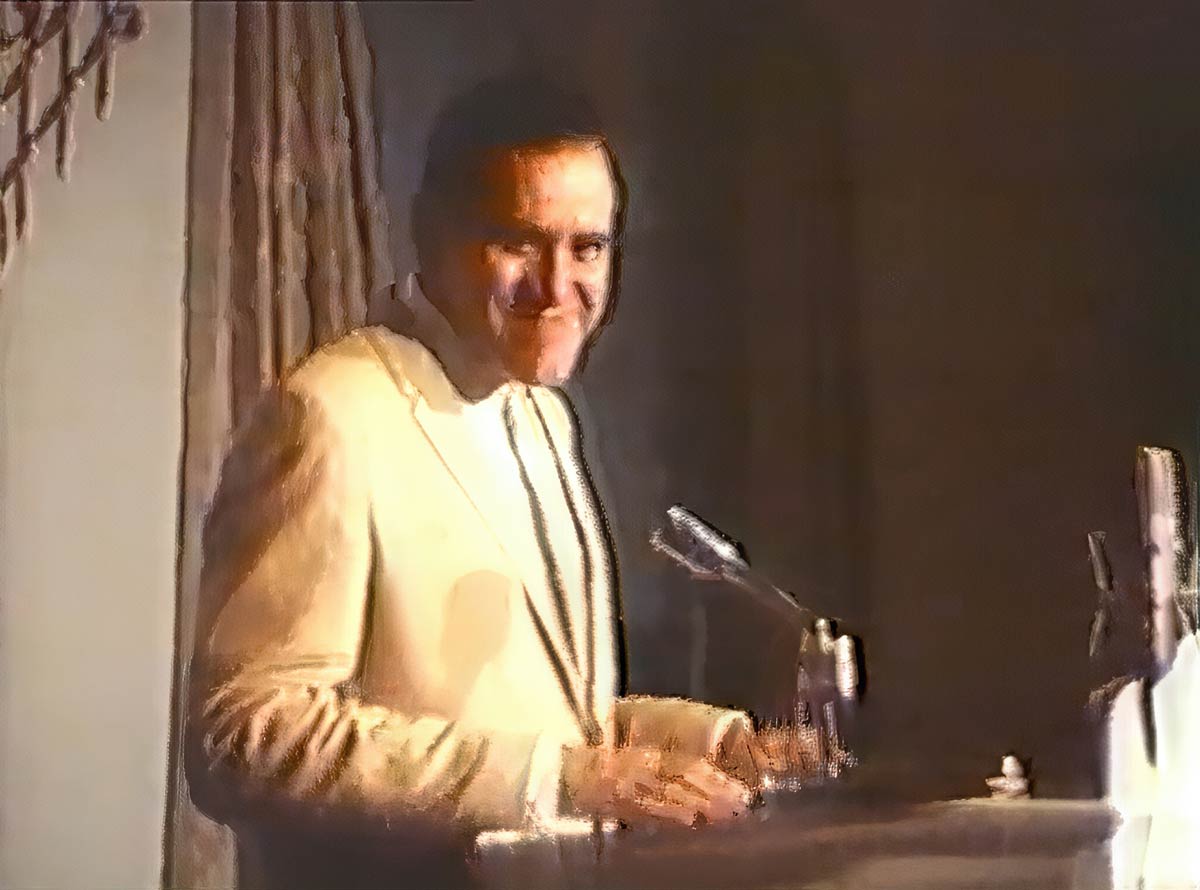
Lanello is a man who always loved life and loved people. There is nothing that would have delighted him more than to have remained in embodiment for two- or five-hundred years going all over the planet, loving people and talking to them. He just loved to talk to people and never ceased to be interested in people of all sorts.
Mark used to travel across the country. And wherever he would go—a café, a drug store, a gas station—he would stop and talk to the working people. He loved the working people. Mark Prophet is the guru of the little people, the farmers, the laboring classes all over America—as well as everybody else’s guru.
And so for him, to ascend was the ultimate sacrifice so that we could arrive at this point to serve in our mission. Mark worked hard and he worked long. He loved enough to master himself. Self-mastery is the key to adeptship. And Mark certainly demonstrated this.
Lanello, our Ever-Present Guru
And now as the Ascended Master Lanello, he still holds this love for us all. You may contact the magnanimous heart of Lanello, our Ever-Present Guru, through playing the melody “Greensleeves.” The keynote of his identity is contained within the notes of this musical rendition.
Those of us who knew Mark have formed the habit of writing letters to Lanello, telling him of our wants and desires, our burdens, our hopes and wishes. We place these short notes either in our copy of Climb the Highest Mountain or in the Bible and leave them for Lanello to fill. And do you know, he answers almost all our ordinate desires—those that are in accordance with the will of God.
The answer is not always instantaneous, but it is fun to look back over our lists after a period of time and see how many have been answered. Perhaps you would like to join us in this exercise. It is not too late!
In Lanello we have our model for victory. He is our living Guru. Always remember that he is saying to you and to me, “You, too, can make it if you TRY! You can make it in this very life!”
Saint Germain has told us, “Death is either the doorway to infinity or a point of reentry whereby man must eventually return to the finite to undo and redo and to finish that which he has left undone.”
For Mark Prophet, death and hell were swallowed up in Christ’s victory. Truly, Mark lived and died and ascended for his principles and his loves, which were God’s. He exchanged the body terrestrial for the body celestial (1 Cor. 15:40) that we all might live. We have come to know one who walked among us, who knew God and who became one with his everlasting consciousness. He bids us do the same. He takes our hand. He shows us the way.
And yet, Mark traveled a long and hard road in this embodiment to find his way. It was not easy. He began a long, personal search, with many experiences and great disappointments in searching for God.
He found that the religions of the world, and even the alternative movements, were not always what he thought they should be. But he kept right on searching. And somewhere along the line, the Ascended Master El Morya made his appearance. We have all heard, “When the pupil is ready, the Teacher appears.”
CLICK HERE TO READ MORE | SONG 514 TO OUR BELOVED LANELLO | CLICK HERE TO WATCH MARK’S MOVIE
The Summit Lighthouse®
Ascended Master Library
The Gold Mine Is Here
- Over 1300 lectures by Mark and Elizabeth Clare Prophet on angels, auras, healing and more
- Over 4100 dictations by the ascended masters on the spiritual path and how to attain your mastery
- Spiritual songs to the angels, ascended masters and hierarchs of the nature kingdom, violet flame, protection and healing decree services for your devotions, chakra alignment, karma balancing, aura cleansing and anchoring peace on the planet!
- Search by ascended master, date, category and more.
The Archives
For additional information please visit the Summit Lighthouse website. Learn how to become a Keeper of the Flame.